9/11, Progressive Foreign Policy, and the Next 25 Years: A Vision for the Future
“If they’re going to hang me, I’ll bring my own rope—and my own bottle of Scotch.”
Dear Friends,
Today marks the twenty-fifth anniversary of the September 11th attacks—a moment that forever changed our country, our politics, and the course of countless lives, including my own. In the days after 9/11, I declared my major in international relations, determined to understand the world and help shape a better future. I came of age during this turbulent time, searching for answers and perspective in a world that suddenly felt uncertain and divided. I remember listening to Noam Chomsky, the first speaker I heard at the University of San Francisco, as he challenged us to think critically about power and foreign policy. But I didn’t stop there—I also sought out voices from across the political spectrum, attending talks by people like Allen Horowitz at SFSU and, most memorably, meeting career diplomats from around the world, including Paul Bremer, Israel’s Daniel Ayalon, and Dennis Ross during my internship at the World Affairs Council.
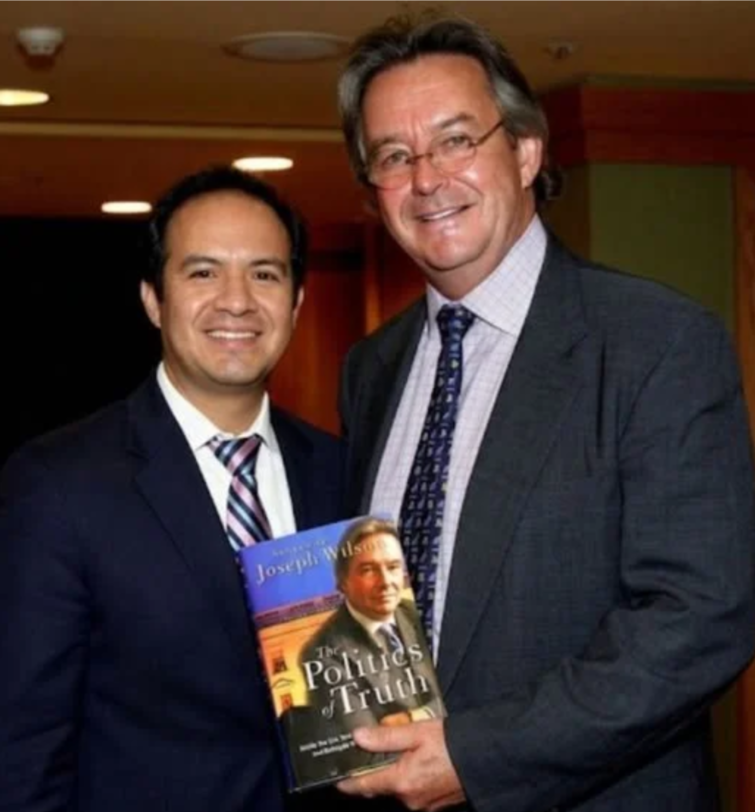
Among those encounters, one stands out: Ambassador Joseph Wilson, a lifelong Republican and the last acting U.S. ambassador to Iraq during the first Gulf War. At a time when political lines seemed etched in stone, Ambassador Wilson’s courage to publicly question his own party and administration left a lasting impression. His now-famous New York Times op-ed, “What I Didn’t Find in Africa,” exposed the truth behind the Bush Administration’s attempts to justify war in Iraq. For someone raised in a Democratic household, it was eye-opening to see a Republican diplomat speak so candidly, reminding me that integrity and independence matter more than party lines. That was the beginning of my own journey toward political independence.
When I met Ambassador Wilson at the World Affairs Council in San Francisco in 2004, he ended his book talk with a story that has stayed with me ever since. As Benjamin Franklin was leaving the Constitutional Convention, a woman approached him and asked, “What kind of government have you given us?” Franklin replied, “A republic, if you can keep it.” Wilson reminded us that the preservation of our democracy has always depended on the engagement and vigilance of ordinary people. We, the people, hold the power to shape the future we deserve.
Two and a half decades later, the lessons of 9/11 remain urgent. We must reckon with the ironies of American foreign policy—such as the long-standing security-for-oil relationship with Saudi Arabia, first formalized by President Franklin D. Roosevelt; most of the 9/11 hijackers came from that country. If we are to truly protect our nation and honor those we lost, we must move beyond old alliances that undermine our values.
Our history offers a cautionary tale about what happens when oil and strategic interests are valued over democracy, human rights, and respect for a people's right to determine their own future. In the 1950s, the United States overthrew Iran’s prime minister, the first democratically elected leader in the entire Middle East, radicalizing Iranian society and setting the stage for the 1979 revolution. In other words, by prioritizing oil over U.S. values, the Middle East is now suffering the consequences of U.S. foreign policy failures. Today, we see echoes of this pattern: the current war with Iran have only served to solidify the power of Iran’s military over the clerics and strengthen hardliners at the expense of moderates and civil society. When we fail to uphold our principles, we not only undermine our own values but also risk creating new cycles of instability.
That’s why I believe in a new, progressive foreign policy—one that prioritizes human rights, democracy, and genuine security over short-term interests. We must lead with our values, supporting diplomacy and development, not just military might.
Here in Nevada’s Second Congressional District, we have an opportunity to put these principles into action. This is why I’m running for Congress in 2028 on a Green Marshall Plan—a bold vision that would not only transition us to clean energy and create good-paying jobs, but also provide a universal basic income to empower every American. Through the “lithium loop,” we can strengthen our local economy and help our country achieve energy independence. By investing in renewable energy and the critical minerals needed for a clean future, we are not only building Nevada’s prosperity, but also making America stronger and more secure. The movement for progress continues, and I am proud to stand with all of you in this fight.
As we remember 9/11 this year, let’s honor the past by shaping the future. Our nation’s story has always been written by those who step forward with hope and determination. It is the power of ordinary people—your voices, your votes, and your vision—that will determine the course of our country. We are not passive observers of history; we are its authors. Together, we can build a future rooted in justice, opportunity, and peace—a future worthy of the promise of America.
Thank you for being part of this movement. Together, we have the power to shape a brighter future—one filled with hope, progress, and unity. Let’s continue working side by side to create the next twenty-five years, guided by the hard-won lessons of our past and the belief that, united, we can achieve the future we all deserve.
With hope and determination,
Gamy Enriquez, MPA
References and Further Reading:
- Craig Unger, House of Bush, House of Saud (2004)
- Joseph Wilson, The Politics of Truth (2004)
- Joseph Wilson, "What I Didn’t Find in Africa," The New York Times, July 6, 2003
- Noam Chomsky, 9-11 (2001)
- Lawrence Wright, The Looming Tower: Al-Qaeda and the Road to 9/11 (2006)
- Steve Coll, Ghost Wars: The Secret History of the CIA, Afghanistan, and Bin Laden (2004)
- The 9/11 Commission Report (2004)
- Rachel Bronson, Thicker Than Oil: America’s Uneasy Partnership with Saudi Arabia (2006)
- Peter Bergen, The Longest War: The Enduring Conflict between America and Al-Qaeda (2011)