Amp'ari Refugee Camp 11/05/2026
Friends,
Welcome to Day Two of our fact-finding mission in the occupied Palestinian territories. Today’s journey took us from the enclosed confines of one of the region's oldest refugee camps to the vibrant, historically rich streets of Ramallah. Throughout the day, we witnessed both the enduring struggles of displacement and the remarkable resilience of a people rooted in history, culture, and community.
Amp'ari Refugee Camp: Forced Displacement & Historical Parallels
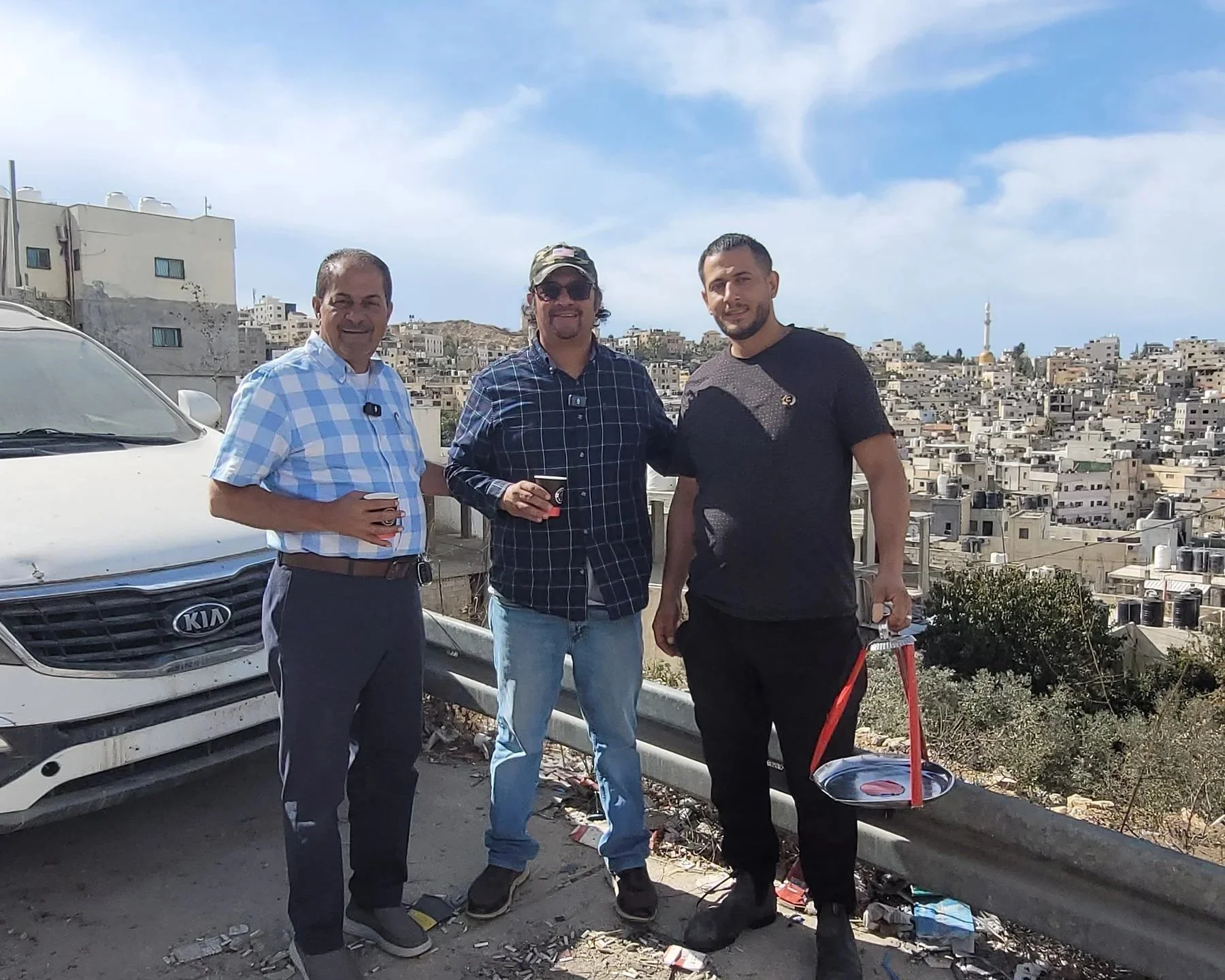
Our day began at Amp'ari Refugee Camp (مخيم الأمعري), located adjacent to Al-Bireh and Ramallah. Established in 1949 by UNRWA, the camp was created to provide temporary shelter for Palestinians displaced from towns and villages near Jaffa, Lydda, and Ramle during the 1948 Nakba. Today, decades later, what was meant to be temporary has turned into dense, multi-generational concrete neighborhoods, where thousands continue to live under severe spatial and infrastructural constraints.
Looking out over the camp, it is impossible not to draw direct parallels to the history of our own country in the United States. Under the banner of Manifest Destiny, European settlement and federal policy forcibly displaced Indigenous nations across America—including the Northern Paiute and Western Shoshone peoples in Nevada's Second Congressional District. Or the Mexican-American War of 1846 to 1848, pursued under the expansionist logic that grew out of the Monroe Doctrine, in which the United States waged a widely criticized war of conquest against Mexico and, through the Treaty of Guadalupe Hidalgo, annexed roughly half of Mexico's national territory. In each of these instances, systemic land loss, forced containment, and the denial of sovereignty severely curtailed the economic opportunity and quality of life for indigenous and Mexican communities alike.
While walking through Amp'ari, we met a young man who was born and raised entirely within the camp. With overwhelming warmth, he offered us morning coffee—completely complimentary—and shared his personal story and aspirations. Seeing his natural entrepreneurial drive highlighted a striking contrast: imagine how much more his talent and potential could flourish if his quality of life were not constrained by the realities of growing up in a refugee camp.
UN Schools & the Impact of Public Defunding
Leaving the camp, we made a stop at a local United Nations–funded school (UNRWA) to meet with a municipal official and discuss the state of public services. Our conversation focused heavily on the severe funding crises experienced in recent years—most notably under the Trump administration, which abruptly cut hundreds of millions of dollars in U.S. contributions to UNRWA. The official outlined how those sudden budget shortfalls directly threatened primary education, basic healthcare, and community stability for thousands of youth.
Standing in that schoolyard, the international crisis resonated deeply with dynamics we face back home in Northern Nevada and across the United States. There is a clear parallel between the international defunding of humanitarian aid and the domestic, systematic starvation of American public education and social safety nets. Grounded in ideologically driven agendas, these cuts disproportionately harm marginalized communities and people of color, while ultimately weakening the entire social fabric. Starving schools of resources creates the very conditions that fuel the school-to-prison pipeline, replacing opportunity with institutional hardship.
Whether in Nevada or the West Bank, undermining public education weakens the bedrock of stable communities. Restoring and "supercharging" funding for domestic public education as well as international institutions like the United Nations—which the U.S. helped build following World War II—is essential. Decades of data show that the post-WWII multilateral framework, while imperfect, has played a vital role in preventing great-power military competition that could spiral into global conflict. Reinvesting in these international and local educational institutions is not just a matter of relief; it is a vital investment in global stability and human potential.
Commercial Vibrancy & Historic Commerce in Ramallah
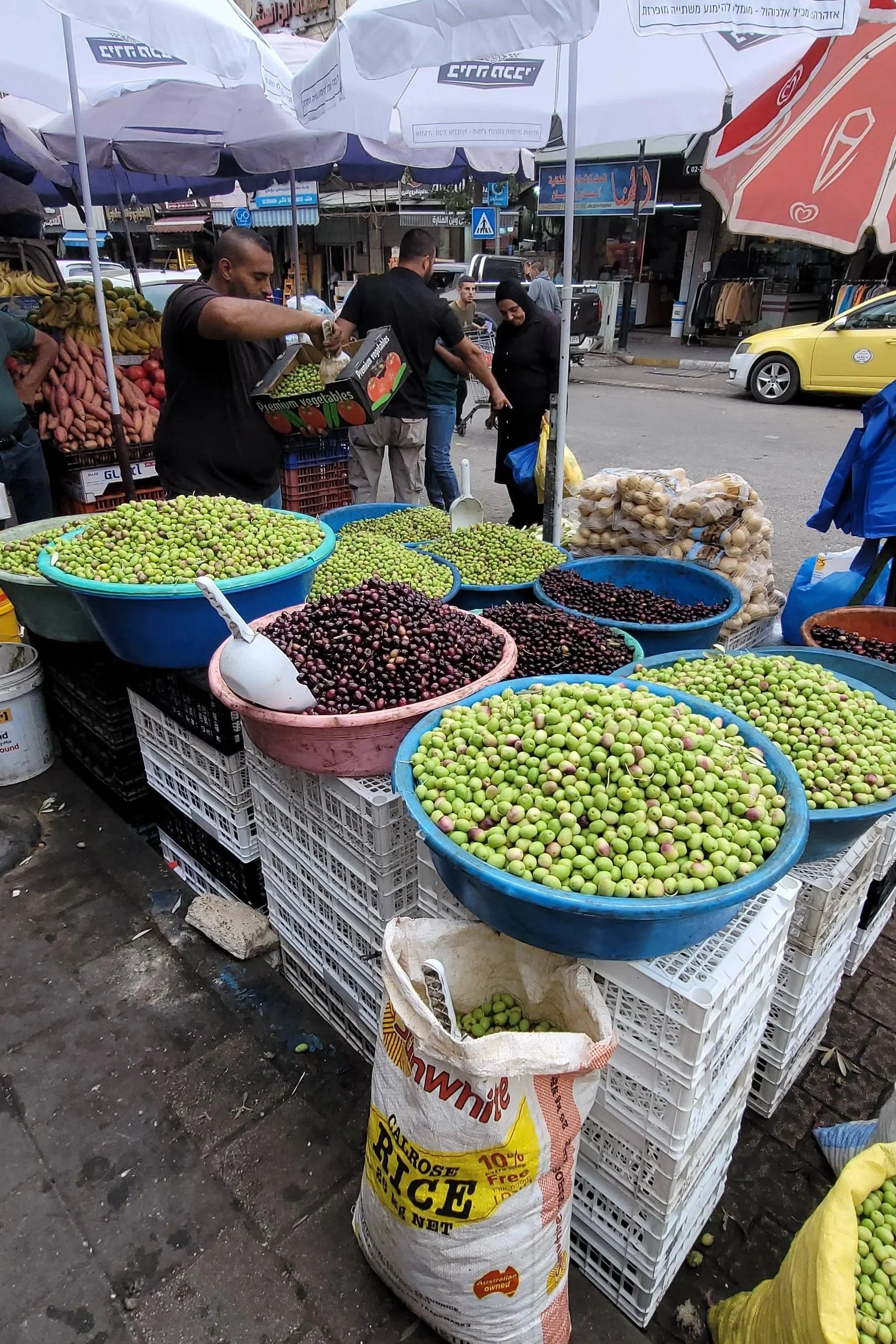
From the school, we traveled into the center of Ramallah, a city that immediately impresses visitors with its cultural diversity, financial vibrancy, and dynamic commercial energy. Ramallah’s history traces back centuries, evolving from a 16th-century agricultural village under Ottoman rule into a bustling economic and administrative center.
While exploring the busy commercial quarters, we were introduced to a local merchant family that has been operating their business continuously since the Ottoman era. Their long-standing presence reflects a deep tradition of trade and commercial acumen passed down through generations. During our visit, we established a business contact for traditional keffiyehs and purchased several authentic pieces—for my family as well as for our campaign volunteers back home in Nevada’s Second Congressional District—as a symbol of solidarity and support for local small businesses.
Architectural Heritage & Interfaith Coexistence
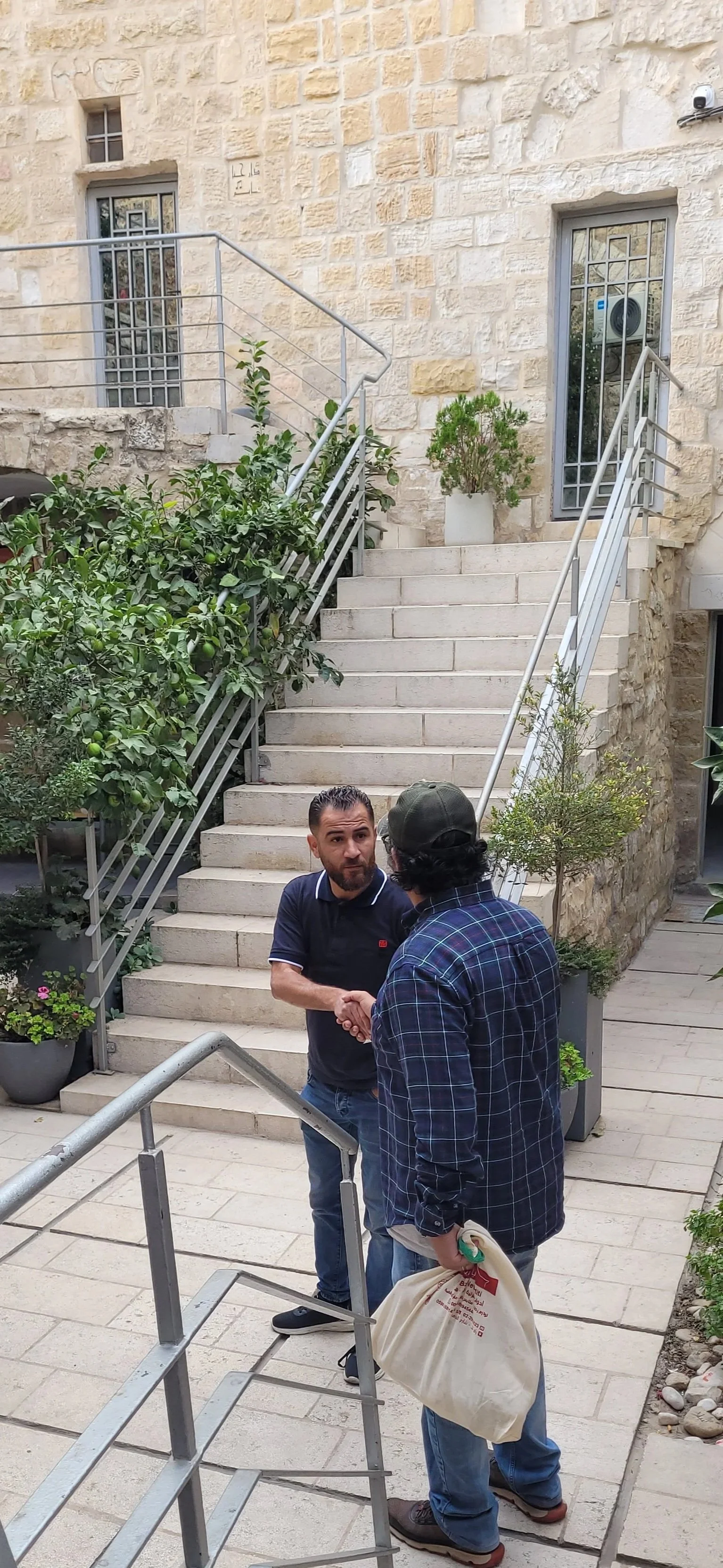
Beyond its bustling markets, Ramallah’s architectural landscape tells a multi-layered story of continuity. Walking through the historic center reveals preserved stone structures, traditional courtyard homes, and intricate arched doorways built over centuries.
Nowhere is this heritage more meaningful than in the heart of the city, where a historic mosque and a historic church stand just a few blocks away from each other. Both structures remain remarkably well-preserved, serving as living testaments to a long tradition of interfaith harmony. In a region often framed solely through the lens of conflict, seeing these sacred spaces shared in such close proximity demonstrates the real potential for people of major world faiths to live side-by-side in peace and mutual respect.
Culinary Traditions & Moving Forward
We rounded out our second day by experiencing Ramallah’s rich culinary traditions. No visit to the city is complete without stopping at Rukab’s Ice Cream (رُكَب), the oldest ice cream parlor in Ramallah, established in 1941—years prior to the founding of the modern state of Israel. Enjoying their famous handmade, stretchy booza served as a memorable reminder of the deep, unbroken history of Palestinian small businesses and cultural life.
Alongside our stop for ice cream, we gathered at a local street spot to enjoy fresh beef shawarma and hot falafel straight off the spit. Watching the street vendors work with skill and generosity reinforced how central hospitality is to the fabric of daily life here.
Throughout the day, we also had the privilege of meeting dozens of Palestinians across these cities who were incredibly cheerful, happy to shake our hand and ask us questions about America and our recent elections. They were equally eager to answer our questions on how we can foster a better dialogue with all faiths and all people in this holy land.
Reflecting on Day Two, from the families of Am’ari Refugee Camp to the historic streets of Ramallah, the overarching lesson is one of profound human dignity. As this fact-finding mission continues, these personal interactions and historic community pillars reaffirm our commitment to advocate for peace, equity, self-determination, and shared prosperity both at home in Nevada and around the world.
Join Us in October 2027
If you live in the great state of Nevada and feel called to witness this reality firsthand, I invite you to join us on our upcoming cost-free fact-finding mission in October 2027 to stand shoulder-to-shoulder with our Palestinian brothers and sisters during the Olive Harvest. There is an undeniable, transformative power in active solidarity—when we show up in person, share in the labor of the land, and bear witness together, we build bridges of hope that no border or barrier can break. Together, we can carry the spirit of the Silver State across the globe, proving that ordinary people standing united in dignity and compassion can truly bend the arc of history toward justice and lasting peace.
In Solidarity,
Gamy Enriquez, MPA
2028 Congressional Candidate
Nevada’s Second Congressional District