When the Cameras Never Blink: Flock, the Fourth Amendment, and the Fight to Restore Our Constitutional Rights
Friends,
I want to tell you about a company most Americans have never heard of, though its cameras have almost certainly recorded you. The company is called Flock. And what it represents is exactly why I decided to run for Congress on a platform of restoring the Constitution in 2026 and why I am running in 2028.
What Flock Is, and Why It Matters
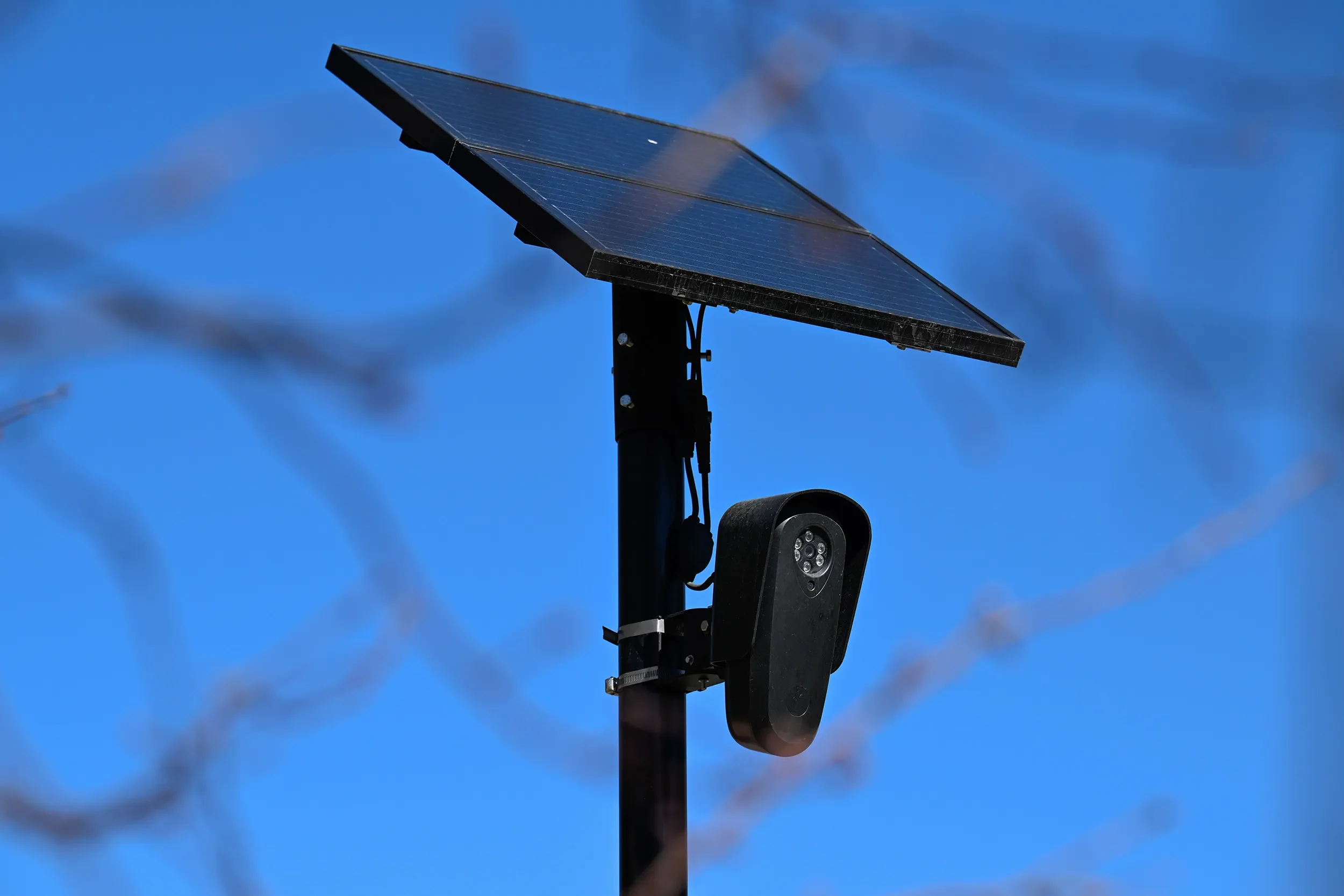
Flock is an automatic license plate reader company used by over 5,000 law enforcement agencies in 49 states across the country—including right here in Nevada, where both local police departments and homeowner associations have adopted Flock cameras in neighborhoods from Las Vegas to Reno. Critics have mapped over 100,000 Flock cameras in use on streets in rural and urban communities, and accuse Flock of building a nationwide mass surveillance system.
These are not ordinary traffic cameras. Flock's surveillance technology records and tracks every car or human that comes into view, and then an AI algorithm catalogs the make, model, color, license plate number, bumper stickers and even scratches. This personal information is then uploaded to a nationwide database that any law enforcement agency with a Flock contract can search, with little oversight on how they use what they find.
As Chad Marlow of the ACLU put it plainly: the cameras take a picture of every single car that goes by, not just the cars suspected of criminality, and put the data into a database kept for a month or more and shared throughout the nation with all of Flock's law enforcement customers, and even internationally with people associated with Flock.
Read that again. Every car. Every driver. Innocent Americans, catalogued and searchable, without a warrant, without probable cause, without so much as a second glance from a judge.
A Balanced Look
To be fair, Flock and its supporters make a real argument. The technology has helped solve crimes, recover stolen vehicles, and locate missing persons. Local police departments, stretched thin, appreciate a tool that does the paperwork for them. Flock goes to local police departments and offers to rent them the cameras, handle storage, and create a back-end system for data sharing, telling them all they need to do is sign on the dotted line. For a small-town chief with a tight budget, that pitch is hard to refuse.
Flock's CEO also insists the company takes no political position on how its data is used. In his own words, when the topic of immigration enforcement comes up, he tells his team the company has no opinion, that if a state wants to enforce immigration it might use Flock, but that's the state's choice, not the company's problem.
That is one view. But the other view, held by Americans across the political spectrum, is that a private company building a searchable, nationwide record of every citizen's movements is not a neutral service. It is infrastructure. And infrastructure, once built, gets used.
The Concerns Are Bipartisan
Flock claims it doesn't work with ICE and that ICE doesn't have direct access to Flock's cameras or data, but a 404 Media investigation last year found more than 4,000 searches that may have been conducted on behalf of or in partnership with ICE. This past May, an audit by the Dayton, Ohio Police Department found its cameras were searched more than 7,000 times for immigration enforcement purposes.
Then came the security failures. A researcher using a commercial search engine easily found the administration interfaces for dozens of Flock cameras. None of the data or video footage was encrypted. No username or password was required. They were completely public-facing, and anyone could point and click through a month of footage like they were watching Netflix.
This is not a partisan concern. As Marlow observed, whether you're libertarian, conservative, MAGA, or progressive, everybody has an objection to Flock, and in a disunited country we have united around opposition to mass government surveillance. In just the last 13 months, nearly 60 municipalities have either canceled their Flock contracts or refused to renew them. Americans, when they learn what is happening, are saying no.
The Line From 9/11 to Today
Here is where this story becomes something larger than one company.
After September 11, 2001, our country made choices under fear that we would never have made under calm reflection. The PATRIOT Act. Warrantless wiretaps. Bulk metadata collection revealed by whistleblowers years later. Watchlists without due process. Airport searches without suspicion. Each one was sold as temporary. Each one was sold as necessary. Each one quietly became permanent.
The Fourth Amendment promises that we shall be secure in our persons, houses, papers, and effects against unreasonable searches and seizures, and that no warrants shall issue but upon probable cause. That is not a suggestion. It is the law of the land, the settled promise of a free people to themselves.
Flock is what happens when that promise erodes for a quarter century. It is the private-sector inheritor of a post-9/11 mindset that treats every citizen as a suspect to be catalogued rather than a free person to be trusted. It did not appear from nowhere. It grew in soil we tilled ourselves, when we accepted the premise that safety requires surveillance and that surveillance of the innocent is the price of catching the guilty.
That premise is wrong. It was wrong in 2001. It is wrong today.
Why I Am Running
I am not running for Congress to score points against the other party. The erosion of our constitutional rights is not a Republican problem or a Democratic problem. Both parties voted for the surveillance state. Both parties renewed it. Both parties looked the other way while private companies filled in the gaps government agencies were told they could not.
I am running because someone in Congress has to stand up and say the quiet part out loud: the Constitution is not optional, the Fourth Amendment is not obsolete, and the American people are not a database.
Concretely, that means legislation requiring warrants for access to license plate reader data, strict retention limits, a ban on sharing this data with foreign entities, transparency requirements before any local government signs a Flock-style contract, and real penalties when companies leave the personal movements of millions of Americans exposed on the open internet.
Nearly 60 towns have already said enough. Now we need Congress to catch up.
Thank you for standing with me. The Constitution is worth restoring, and together we will restore it.
In liberty,
Gamy Enriquez, MPA
Candidate for Congress 2028
References
-"Automatic License Plate Readers in Nevada," Nevada Current, https://www.nevadacurrent.com/2023/03/14/automatic-license-plate-readers-in-nevada/
- American Civil Liberties Union (ACLU): "What Are Automated License Plate Readers (ALPRs)?" https://www.aclu.org/issues/privacy-technology/surveillance-technologies/automated-license-plate-readers-alpr
- 404 Media: "Police Used Flock Cameras to Search for Immigration Offenses Thousands of Times" https://www.404media.co/police-used-flock-cameras-to-search-for-immigration-offenses-thousands-of-times/
- Electronic Frontier Foundation (EFF): "Automated License Plate Readers (ALPRs)" https://www.eff.org/pages/automated-license-plate-readers-alpr
- U.S. Department of Justice: "License Plate Readers for Law Enforcement" https://bja.ojp.gov/sites/g/files/xyckuh186/files/Publications/NIJ_LicensePlateReaders.pdf
- Dayton Police Department Flock Audit Report: https://www.daytonohio.gov/DocumentCenter/View/15810/Flock-Safety-ALPR-Audit