Friends,
When the Berlin Wall fell, the prevailing consensus among Western policymakers and thinkers was that humanity had reached the "end of history." The ideological battle of the Cold War was supposedly over, paving the way for an era defined by liberal democracy, free markets, and seamless globalization. Borders were meant to become increasingly permeable, facilitating the flow of goods, capital, and ideas.
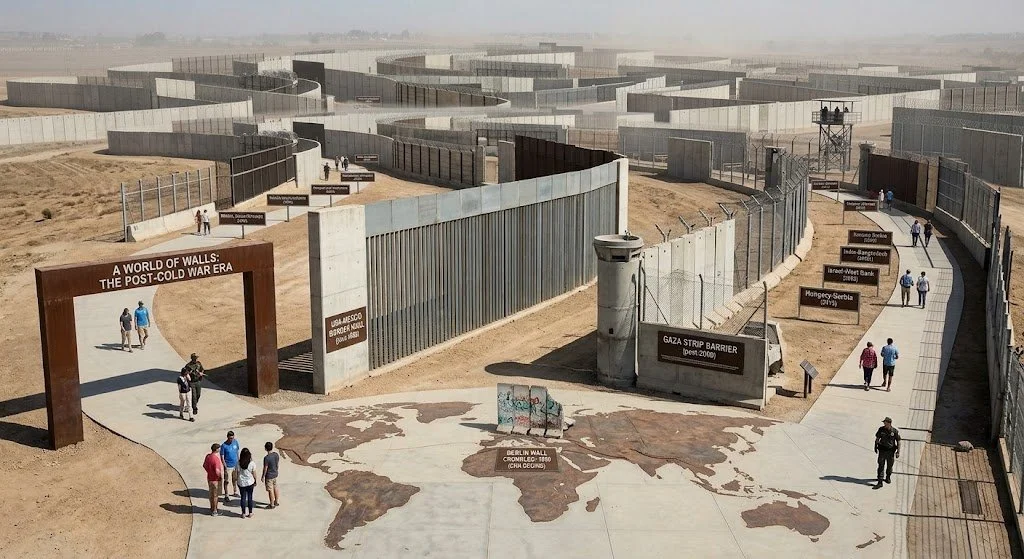
However, the reality that has unfolded reflects a starkly different narrative. Far from dissolving, national boundaries are being violently reinforced, evidenced by the proliferation of fortified border walls and high-tech barrier systems across the globe.
Irony of this reversal isn't merely academic; it represents a fundamental contradiction in the post-Cold War promise. The forces of globalization were celebrated as inherently progressive, yet the very architecture of the capitalist world economy has created conditions that demand such walls.
To understand this, one must examine who benefits from the construction and management of these barriers. The rise of modern border security has generated unprecedented profits for defense contractors, technology firms, and private prison corporations. This military-industrial complex benefits immensely from the sustained perception of a border crisis.
More profoundly, however, these walls serve a specific ideological purpose. For reactionary, fascist, and white supremacist forces, the border wall is not merely a defense against migration; it is a psychological tool of population control and, in its extreme manifestations, a form of social elimination.
Within these ideologies, the demarcation of "inside" and "outside" is inextricably linked to notions of racial or national purity. The rhetoric framing migrants as an "invasion" directly justifies the use of lethal force and the implementation of harsh detention policies. By defining the migrant as a threat to the existence of the dominant group, the wall becomes a necessary instrument to prevent perceived cultural extermination.
Globalization, as envisioned by neoliberal consensus, failed to account for the resurgence of ethno-nationalism. Rather than breaking down barriers, the economic disparities exacerbated by global capital have fueled the very fears that reactionary forces exploit to gain political power.
The construction of border walls is, therefore, a physical manifestation of a global retreat from the ideals of open societies. It signals a return to an era where sovereignty is defined by exclusion and the management of human beings based on their origin.
In conclusion, the ironic proliferation of border walls in the post-Cold War era demonstrates the persistent power of exclusionary ideologies. These barriers are not only monuments to nationalism but also physical representations of a worldview that seeks to contain and control populations to maintain supremacy.
In Solidarity,
Gamy Enriquez, MPA