Adam Smith, the Wealth of Nations, and the Paradox of Free Movement
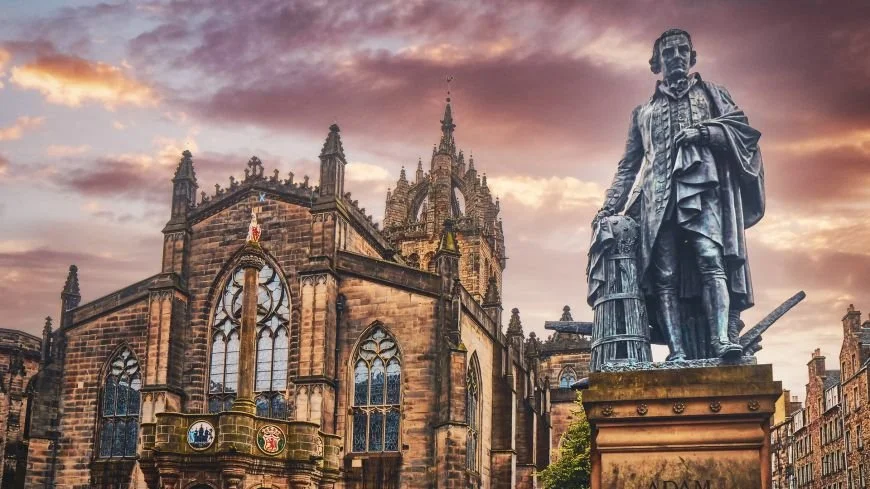
Adam Smith Statue, Edinburgh, Scotland
Dear friends and supporters,
As we celebrate 250 years of America's independence, it is worth reflecting on the ideas that helped shape our nation and the world. One of the most influential figures in this regard is Adam Smith, whose seminal work, "The Wealth of Nations," was published in 1776—the very year of our country's birth. Smith’s advocacy for the free movement of products, services, capital, and people laid the intellectual groundwork for what we now call capitalism. Yet, as we reflect on his influence during the drafting of the U.S. Constitution and the birth of American economic policy, it is crucial to examine how his principles have been selectively applied—and the consequences of this selectivity.
Adam Smith is celebrated as the father of capitalism, and for good reason. His vision was one of open markets where goods, services, capital, and people could flow freely, fostering prosperity, innovation, and competition. The founding fathers, inspired by Smith’s ideas, designed a system that valued economic freedom and individual liberty. Over the centuries, these principles have guided the evolution of the American—and global—economy.
However, there is a glaring contradiction in how Smith’s vision is practiced today. In our modern globalized economy, capital—money—moves across international borders with unprecedented ease. Multinational corporations can invest, extract profits, and shift operations almost anywhere around the globe, often without significant restriction. Products and services, too, cross borders with relative freedom, especially through trade agreements designed to facilitate this movement. These policies are often justified in the name of efficiency, cost savings, and consumer benefit.
“People of the same trade seldom meet together, even for merriment and diversion, but the conversation ends in a conspiracy against the public, or in some contrivance to raise prices,”
But when it comes to people—the workers who produce the goods and provide the services—borders remain firmly closed. Immigration laws and border controls restrict the movement of people far more tightly than the movement of money or merchandise. This selective freedom creates a system where the benefits of globalization accrue disproportionately to multinational corporations and wealthy nations, while the costs—economic instability, job displacement, and social upheaval—are often borne by developing and emerging economies.
Nowhere is this imbalance more evident than in Latin America. The free movement of capital has enabled corporations to seek cheap labor and resources in these countries, but it has also led to economic volatility, environmental degradation, and weakened local industries. Trade agreements that emphasize the free flow of products and services often undermine local markets and erode the livelihoods of small farmers and businesses. Meanwhile, people in these destabilized economies are denied the same freedom to seek opportunity across borders, trapping them in cycles of poverty and migration pressures.
It is time to recognize the connection between these policies and the real-world consequences they produce. When capital and goods move freely but people do not, we create a world where profits are prioritized over human dignity and stability. We see the effects in the waves of migration from Latin America, driven not just by poverty or violence but by economic systems designed to benefit the few at the expense of the many.
This is why, when I ran for Congress, I advocated not for so-called "free trade," but for fair trade. Fair trade prioritizes social and environmental well-being, ensuring producers in developing countries receive fair prices, safe working conditions, and use sustainable practices. In contrast, free trade focuses on reducing tariffs and barriers to allow goods to move across borders with minimal government intervention. Philosophically, fair trade draws on ethical frameworks like Kantian ethics, which emphasize treating people with respect and not as means to an end, as well as Catholic social teaching and social justice movements that call for systemic fairness and the protection of vulnerable workers.
Fair trade means rethinking our priorities and recognizing that true economic freedom must include people, not just money and products. It means building a system that balances the rights and needs of workers, communities, and nations—one that honors Adam Smith’s vision in its entirety, not just the parts that serve special interests.
As we reflect on the legacy of the Wealth of Nations, let us ask: What would a truly free and fair global economy look like? And how can we move closer to the ideals that inspired the founders of our nation? Only by grappling with these questions can we build a future that delivers on the promise of economic liberty for all.
Gamy Enriquez, MPA
References:
Adam Smith, "The Wealth of Nations" (1776)
Joseph E. Stiglitz, "Globalization and Its Discontents" (W.W. Norton, 2002)
Oxfam International, "Fair Trade: What's it all about?" (https://www.oxfam.org/en/fairtrade)
Institute for Policy Studies, "The Case for Fair Trade" (https://ips-dc.org/the-case-for-fair-trade/)
Catholic Relief Services, "Catholic Social Teaching and Fair Trade" (https://www.crs.org/get-involved/learn/fair-trade)
Fair Trade Federation, "What is Fair Trade?" (https://www.fairtradefederation.org/what-is-fair-trade/)
World Fair Trade Organization, "10 Principles of Fair Trade" (https://wfto.com/fair-trade/10-principles-fair-trade)