Connecting Middle East Military Presence to Domestic Inequality: Why the Fight for a Green Marshall Plan Is Only Beginning
Dear friends and supporters,
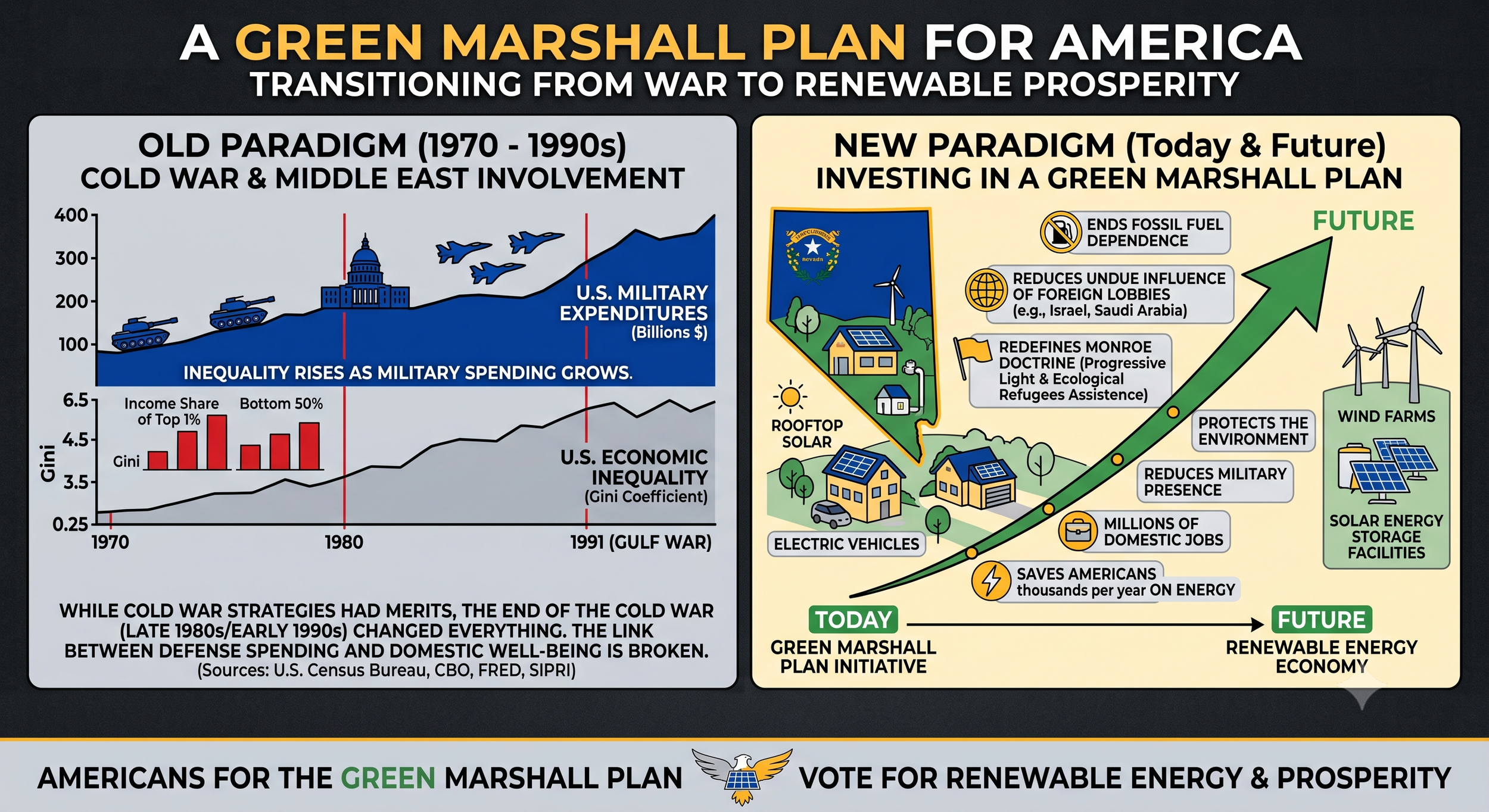
In a landmark statement on July 21, 2026, the U.S. Secretary of Defense revealed that the ongoing conflict with Iran has cost taxpayers over $37 billion—and warned that even more funding is being requested. As headlines focus on the immediate geopolitical stakes, it’s critical to step back and ask: how does vast, decades-long military investment in the Middle East ripple back into the everyday lives of Americans? When I ran for Congress during the 2026 primary election in Nevada’s 2nd Congressional District, I saw firsthand how these policies perpetuate domestic inequality. That’s why I built my campaign around a Green Marshall Plan—one that would redirect our resources to directly benefit working families through a universal basic income (UBI) and sustainable infrastructure. While my campaign has ended, the movement for a Green Marshall Plan is only just beginning.
To understand the urgency and direction of this movement, we must also recognize where we stand geopolitically. The U.S. Empire as we know it is dying a slow death in the Middle East—with the shifting control of key chokepoints like the Strait of Hormuz and now the Suez Canal. According to historian Alfred McCoy, for the last thousand years, empires that managed to control Eurasia set the global agenda; those that lost control, like the British Empire after the Suez Crisis of the late 1950s, lost their place on the world stage. Similarly, empires that harnessed the dominant energy sources of their era—the Portuguese and Spanish with enslaved labor, the British with steam, and the Americans with fossil fuels—gained global power. Ironically, our dependence on fossil fuels has become our Achilles' heel. That’s why it is critical that we transition to renewable, productive energy if we want to shape the future rather than be left behind by it. Let’s break down how our military posture in energy-rich regions like the Middle East structurally links to growing economic divides at home:
1. Opportunity Cost & Resource Allocation
Since 2001, the U.S. has spent more than $8 trillion on post-9/11 wars and related military operations in the Middle East and Central Asia (Cost of War Project, Brown University). These funds haven’t just disappeared—they’ve been actively redirected away from domestic priorities.
Every dollar allocated to long-term overseas deployments is a dollar not invested in our communities. Instead of funding public infrastructure, universal healthcare, affordable higher education, or subsidized childcare, we’ve prioritized military expenditures that disproportionately benefit a narrow set of interests. The result? Working- and middle-class households are left with underfunded schools, crumbling roads, rising healthcare premiums, and a social safety net stretched to its limits. The trade-offs are not abstract: they represent real lost opportunities for millions of Americans, especially in states like Nevada.
2. Concentration of Defense Capital
A second structural mechanism is the concentration of capital within the defense sector. Much of our military budget flows to private contractors—procurement giants, logistics firms, and defense technology companies. Over the past two decades, this channeling of federal funds has enriched corporate executives and institutional shareholders, creating windfall profits and accelerating capital gains for the top 1%.
Meanwhile, manufacturing wages have broadly stagnated, even as productivity has increased. While the defense sector touts job creation, these gains are unevenly distributed and often fail to uplift the broader working population. Instead, the benefits accrue to a small group of stakeholders, widening the wealth gap and leaving everyday citizens behind.
3. Oil, Petrocurrency, and Macroeconomic Stabilization
Military presence in the Middle East is not just about security—it’s about oil and the stabilization of global financial flows. Since the Carter Doctrine in 1980, successive administrations have viewed Persian Gulf stability as essential to maintaining the primacy of the U.S. dollar in global energy markets. This strategy benefits multinational oil conglomerates and global financial markets, shoring up profits for corporate actors far removed from the communities bearing the costs.
But here’s where the asymmetry becomes stark: while the rewards of global energy stability flow to multinational corporations and investors, the risks and burdens—financial, physical, and emotional—fall on working-class service members and American taxpayers. Military families make profound sacrifices, and taxpayers in Nevada and beyond foot the bill for endless overseas operations, rather than investments that could transform their everyday lives.
The $37 Billion Iran War Tab: A Tipping Point
Today’s revelation that the Iran conflict has cost over $37 billion only underscores the urgency of changing course. With the Pentagon seeking even more funding, Americans are right to ask: what if we invested that money here at home instead?
Why I Ran: A Green Marshall Plan for Real Security
This is precisely why I ran for Congress in Nevada’s 2nd District during the 2026 primary election. My platform centered on a Green Marshall Plan—an ambitious, forward-looking initiative to:
Redirect Military Spending: Shift resources from unsustainable overseas operations to investments in clean energy infrastructure, public health, education, and climate resilience.
Fund Universal Basic Income: Establish a national UBI, providing every American with a financial floor to reduce poverty, stimulate local economies, and foster entrepreneurship.
Build Shared Prosperity: Ensure that the dividends of peace, not the profits of endless war, are distributed broadly across all communities.
Yet, this moment is also filled with hope and possibility. We stand at a crossroads: we can either continue pouring billions into foreign military entanglements, or we can build a future where our investments serve the people, not just the powerful. The movement for a Green Marshall Plan is only beginning. We can look for inspiration to Alaska’s Permanent Fund or Norway’s sovereign wealth fund—models that show how shared national resources can directly benefit all citizens through payments, dividends, and strategic investments.
Imagine an America where every person receives a universal basic income, funded by prosperity and innovation in clean energy rather than endless war. By taking bold, collective action now, we can reshape our economy to serve all of us, ensuring a safer, more equitable, and sustainable future for generations to come.
Let’s seize this moment to invest in true security, opportunity, and equality. If you believe we all deserve better, share this vision, subscribe, join the movement, and donate if you can. Together, we can create real change—if we fight for it, for ourselves, our children, and our grandchildren. The future is ours to build.
In Solidarity,
Gamy Enriquez, MPA
---
References
1. Brown University Cost of War Project. (2023). "U.S. Budgetary Costs of Post-9/11 Wars Through 2023: $8 Trillion and Counting." https://watson.brown.edu/costsofwar/
2. Carter Doctrine (1980): President Jimmy Carter, State of the Union Address, January 23, 1980.
3. U.S. Department of Defense. (2026). Secretary of Defense Press Briefing on Iran War Costs.
4. Mearsheimer, John J., and Stephen M. Walt. (2007). "The Israel Lobby and U.S. Foreign Policy." Farrar, Straus and Giroux.
5. Bard, Mitchell. (2010). "The Arab Lobby: The Invisible Alliance That Undermines America's Interests in the Middle East." HarperCollins.
6. Congressional Research Service. (2022). "U.S. Foreign Aid to Israel."
7. Alaska Permanent Fund Corporation. https://apfc.org/
8. Norges Bank Investment Management. "The Norwegian Government Pension Fund Global." https://www.nbim.no/en/