Friends,
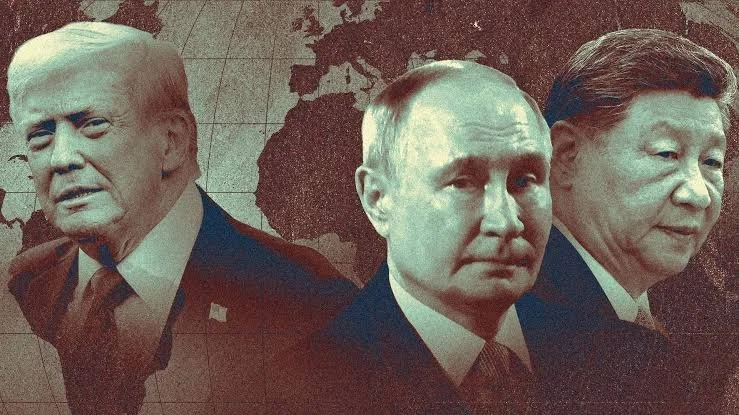
In a moment many are calling the most significant diplomatic gathering since 1945, Chinese President Xi Jinping hosted both Donald Trump and Vladimir Putin for a historic trilateral summit in Shenzhen this week. I watched as the three leaders, representing the world's biggest nuclear powers, spent roughly 90 minutes together before issuing what their governments called a "peace declaration."
What the declaration says
Reading through the four-point statement, I saw an affirmation that "nuclear war cannot be won and must never be fought," alongside a commitment from the three countries to dialogue on reducing nuclear risks and preventing proliferation. However, several provisions immediately stood out to me: a pledge to increase production of refined petroleum products, a call for reforms at the United Nations, and language urging the International Criminal Court and similar bodies "not abuse their jurisdiction." It is worth noting that none of the three countries are ICC signatories, and the court currently holds an outstanding arrest warrant against Putin for war crimes related to the deportation of Ukrainian children.
Three leaders, three different agendas
From my perspective, each leader arrived with a distinct purpose. Xi opened the summit by calling it "a historic meeting" aimed at discussing how to "safeguard world peace and promote strategic stability," while describing a world "undergoing rapid changes unseen in a century." Putin spoke of a desire for "constructive, partnership-based cooperation rooted in mutual respect," while Trump framed the gathering around the value of "open, respectful and productive dialogue," arguing that "no peace was ever forged by declining opportunities for engagement."
To make sense of the moment, I looked to the analysis of Scott Lucas, professor of international politics at University College Dublin's Clinton Institute, who appeared on Democracy Now! Lucas offered a sharp read on what actually happened behind the diplomatic language. He called it "a significant post-1945 moment, which was, you know, the last time that we had great summits, including discussing the future of China, in part because you're looking at a changed international order." As I see it, his assessment hits the mark: the summit exposed a United States no longer leading that old system, a Russia weighed down by its ongoing invasion of Ukraine, and, most importantly, "an ascendant China."
I agree with Lucas's point that China "really set the terms of what was said throughout this," both symbolically, by seating Xi at the center of the table between Putin and Trump, and substantively, through its emphasis on "strategic stability, unity, technology and innovation, and perhaps most striking, free trade." That last point struck me as particularly ironic, since the post-1945 order had been built on American support for free trade—a position the current administration has largely abandoned.
Looking at their individual motives, I found Lucas's assessment blunt but accurate: Trump came for "ego and the photo opportunity," Putin came because of the problems facing his invasion and a hope of enlisting Trump to pressure Ukraine into surrender, while China came purely for strategic advantage, seeking a free hand to pursue its own alternative international system.
International law under strain
I share Lucas's concern over how the leaders treated the International Criminal Court. He explained that Putin, wanted on war crimes charges, does not want to face them, while Trump, eager to maintain his relationship with Putin, effectively backed him by suggesting the ICC "should have no credibility." Lucas framed this as part of a broader pattern that I find deeply troubling: "International order has broken down because certain countries and certain leaders don't believe in international order... I think that's true of Vladimir Putin. And with regret, I think that's also true of Donald Trump and his inner circle. But I think the country that benefits from that lack of respect for international order... is China."
The tech and AI backdrop
I also noticed that the summit came just after Nvidia's CEO Jensen Huang stepped down amid controversy. Lucas connected this to a larger imbalance I have been tracking: China operates with clear strategic leverage through its control of rare earth minerals and magnets, even as it remains dependent on advanced chips. Meanwhile, he described the Trump administration as "almost in chaos," caught between revelations that American firms were generating major revenue from China despite public denials, and reports that the Commerce Department failed to enforce over 100 recommended export controls on China-linked firms. The result, as Lucas put it, is a U.S. government "scrambling and divided" over its actual China policy.
Ukraine, sidelined but central
Even as I followed the main summit, Trump envoys Jared Kushner and Steve Witkoff were separately meeting with Ukrainian President Zelensky and European representatives. I see two competing agendas playing out here, much as Lucas described: Russia's push to sideline Ukraine entirely—calling instead for a new European security architecture that would see NATO withdraw to its 1997 boundaries, leaving the Baltic states and Poland exposed—versus Ukraine and Europe's insistence on a ceasefire, no further territorial gains for Russia, and real security guarantees for Kyiv. Lucas warned that Russia is attempting to tilt this balance by dangling tens of billions of dollars in economic deals, some of which could benefit figures close to Trump, in exchange for ending the war on Moscow's terms.
A new template for global power?
When considering whether this summit signals a future where major powers simply meet among themselves, bypassing the UN Security Council and other multilateral forums, I side with Lucas in resisting the urge to call it a new "order" at all. Instead, I believe it reflects the breakdown of the old one, driven by leaders unwilling to operate within established international norms, with China positioned as the primary beneficiary of that vacuum.
As the world watches whether this three-way meeting produces lasting change or underscores a transitioning global landscape, Lucas's assessment offers a grounded takeaway: power politics alone cannot sustain global stability. Recognizing the reality of shifting power dynamics is the first step toward rebuilding durable institutions capable of managing competition without sacrificing international law.
In Solidarity,
Gamy Enriquez, MPA
2028 Congressional Candidate
Nevada’s Second Congressional District
P.S. We must return to the rules of the road in international relations and reform them in a way that is progressive and reflective of the growing power and voice of the Global South. We cannot risk regressing to the rules of the jungle—where, as Thucydides warned, "the strong do what they can and the weak suffer what they must"—not least because the balance of power is never permanent, and the United States itself may one day find itself in a position of relative weakness.