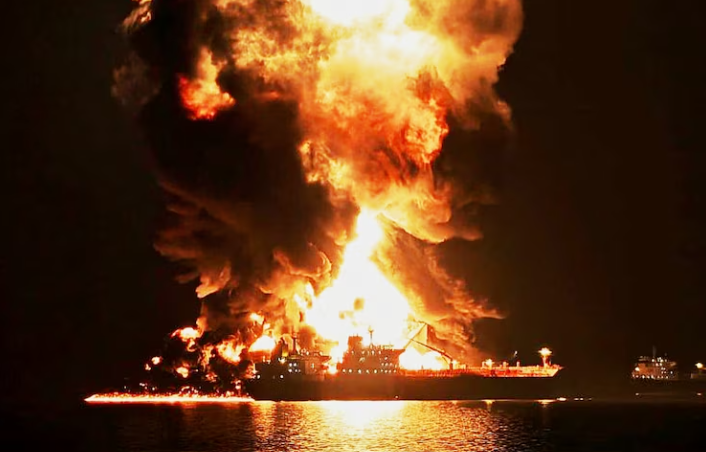
An oil tanker burns after being hit by an Iranian strike in the ship-to-ship transfer zone at Khor al-Zubair port near Basra, Iraq, March 11, 2026.
Friends,
The potential for renewed military escalation between the United States and Iran remains a subject of intense debate, as both nations weigh the strategic risks and geopolitical costs of further conflict. Despite previous strikes, the core objectives—such as dismantling Iran's nuclear capabilities and neutralizing its missile threats—remain largely unfulfilled, leading to renewed pressure for decisive action.
Potential Military Options
Analysts and former defense officials have outlined a spectrum of possible approaches the US and Israel might consider:
Limited Maritime Strikes: This approach focuses on "mowing the lawn" by targeting coastal radars, drone bases, and anti-ship missile sites to safeguard shipping through the Strait of Hormuz. While carrying lower escalation risks, experts note that Iran could likely rebuild these assets relatively quickly. Targeting Nuclear Infrastructure: Recent discussions highlight the possibility of attacking deeply buried sites, such as the facility at Pickaxe Mountain. However, this poses significant tactical challenges, as specialized munitions would be required, and the effectiveness of such strikes remains uncertain given the opacity of Iran's current nuclear program. Expansive Campaigns: A broader strategy could involve a multi-day offensive aimed at Revolutionary Guard commanders, oil refineries, and power plants. While intended to force the regime into compliance, critics warn this could trigger severe humanitarian crises and force the regime to retaliate against critical regional infrastructure.
Escalation Risks and Constraints
The strategic landscape is complicated by significant logistical and geopolitical hurdles:
Depleted Resources: The US military is facing a shortage of critical munitions, specifically interceptors needed for air defense. Replenishing these stocks could take years, limiting the sustainability of a prolonged campaign. Asymmetric Retaliation: Tehran has indicated it is prepared to open "new fronts," potentially targeting regional energy infrastructure, data centers, or even European soil, which would represent a dramatic escalation in the conflict's scope. Questionable Outcomes: Many experts caution that the regime in Tehran has proven resilient. There is skepticism regarding whether air superiority alone can achieve the desired political outcome, with some officials comparing the cycle of escalation to previous long-term military entanglements in the Middle East.
Ultimately, the decision to escalate hinges on balancing the desire for definitive military results against the high probability of a prolonged, costly, and unpredictable regional conflict that could further strain global energy markets and military inventories.
To protect the primary U.S. objective of foreign policy—ensuring the safety and prosperity of the American people—the United States maintains three main strategic interests in the Middle East: ensuring open access to Persian Gulf energy supplies by preventing regional hegemony, stopping the proliferation of weapons of mass destruction (WMD) to protect power projection capabilities and lower the risk of accidental or terrorist acquisition, and countering anti-American terrorism through intelligence-sharing partnerships. While moral considerations warrant supporting Israel's survival, Israel's security is not vital to core U.S. strategic stability compared to the flow of Gulf oil. To safeguard these interests effectively, the U.S. should abandon the post-9/11 strategy of direct military occupation and regional transformation—which fuels anti-American terrorism and drives rivals to pursue WMDs—in favor of "offshore balancing." Under offshore balancing, the U.S. would withdraw permanently stationed ground troops over the horizon, rely on local allies to maintain the regional balance of power, use diplomacy to engage foes like Iran and Syria, and deploy military force only as a last resort to prevent any single power from dominating the region.
The question hanging over global energy policy is whether the durable "oil for security" pact forged between Franklin D. Roosevelt and King Abdulaziz aboard the USS Quincy in 1945 is finally unraveling before our eyes. As shifting geopolitical realignments, fluctuating crude markets, and accelerating climate imperatives erode the foundations of that decades-old Strategic alliance, continuing to tie national stability to international petroleum becomes an increasingly precarious gamble. It is precisely this terminal decline of the legacy fossil fuel security umbrella that makes an All-Green Marshall Plan—one that actively finances a universal citizens' dividend—so urgently critical. By modernizing energy infrastructure while putting cold, direct capital into the hands of everyday citizens, such a blueprint offers both the economic buffer and the strategic independence required to navigate a post-petrodollar world.
In Solidarity,
Gamy Enriquez, MPA
2028 Congressional Candidate
Nevada’s Second Congressional District