Lessons of October 7: Historical Realities, Moral Courage, and the Path to Peace
Friends and Neighbors,
Today marks the anniversary in which the world watched in horror as the events of October 7 2024 unfolded. The violence, loss of innocent lives, and trauma of that day reverberate deeply across our communities and around the globe. As we reflect on this solemn anniversary, we owe it to ourselves—and to future generations—to look past immediate anguish and engage in the honest, courageous, and often uncomfortable analysis required to break the cycle of perpetual war.
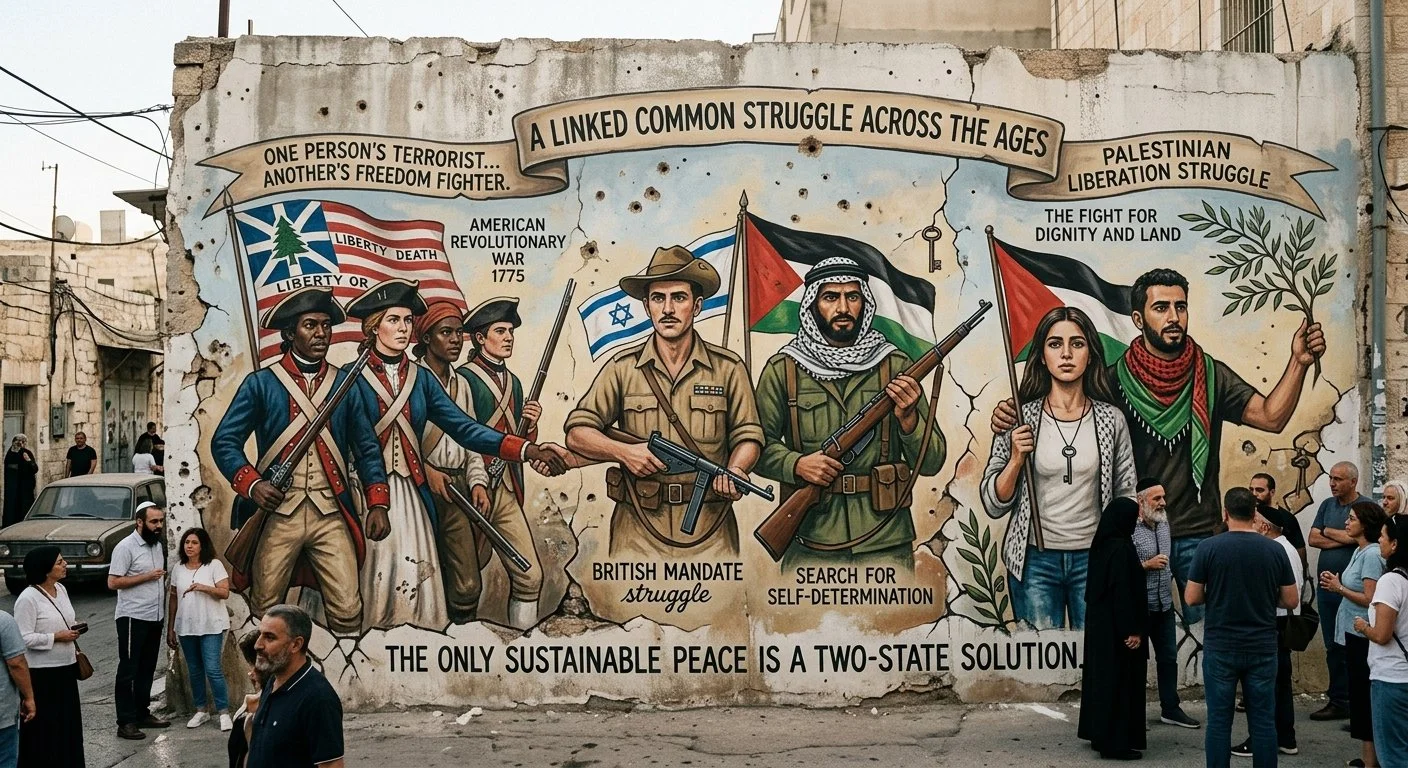
For the last quarter-century as an international relations scholar, I have studied conflict, statecraft, and the delicate mechanics of international order. History teaches us a challenging but inescapable truth: one person's terrorist is another person's freedom fighter.
This distinction depends almost entirely on who holds the pen when history is written.
Consider our own American origins. In the late 18th century—as we proudly mark 250 years since the signing of the Declaration of Independence—the British Crown viewed American revolutionaries not as noble patriots, but as lawless traitors, rebels, and insurgents. George Washington and his Continental Army waged a desperate struggle against an imperial power, employing guerrilla tactics that King George III's regime deemed illegitimate and terroristic.
This dynamic is far from unique to America. When Jewish underground organizations such as the Irgun and the Lehi waged armed campaigns against the British Mandate in the 1940s to establish the modern State of Israel, the British authorities labeled them violent extremists and terrorist groups. Leaders like Menachem Begin and Yitzhak Shamir, who were once hunted by British forces with bounties on their heads, went on to become Prime Ministers of Israel.
Today, Palestinians engaged in national liberation struggles view their fight through a similar lens. Recognizing this historical parallel is not an endorsement of violence or atrocities against civilians; rather, it is an acknowledgment of political reality. Throughout human history, populations living under military occupation, displacement, or perceived subjugation have taken up arms, viewing their struggle as a legitimate quest for self-determination.
However, historical analysis brings us to a second, crucial truth: armed struggle, when detached from a clear and viable political solution, leads directly into the abyss of endless war.
Violence alone cannot build a state, establish civil society, or secure long-term security. When armed groups elevate military struggle to an end in itself—without a credible path toward political compromise—they condemn their own people to continuous devastation and total displacement. Conversely, relying solely on military dominance, border enforcement, and containment without addressing the root political grievances of an occupied people ensures that conflict will periodically explode, as it did on October 7.
The only sustainable exit from this tragedy is a negotiated two-state solution—one that guarantees self-determination, sovereignty, and dignity for Palestinians, alongside absolute security, recognition, and peace for Israelis.
Achieving such a peace requires leadership capable of rising above retribution. For this, we must draw inspiration from President Abraham Lincoln.
At the close of the American Civil War—a conflict that pitted brother against brother and inflicted unimaginable casualties—Lincoln refused the temptation of endless vengeance. In his Second Inaugural Address, facing a deeply divided nation, he called for a magnanimous peace: "With malice toward none; with charity for all... let us strive on to finish the work we are in, to bind up the nation's wounds."
Lincoln understood that a victory achieved through military power is meaningless if it fails to build a lasting political peace. Reconciliation requires political courage: the willingness to see the humanity in an adversary and the foresight to offer a path forward that leaves neither side broken or permanently subjugated.
This is the principle that will guide my work in the United States Congress.
We cannot afford foreign policy driven by soundbites, short-sighted political rhetoric, or unconditional support for unending military operations. We need leadership grounded in historical perspective, diplomatic rigour, and moral clarity.
As your representative, I will fight for an American foreign policy that:
Prioritizes principled diplomacy that leverages U.S. influence to bring all parties to the negotiating table.
Commitment to a viable two-state framework that recognizes both Israeli security needs and Palestinian rights to self-determination.
Upholds international humanitarian law consistently, protecting civilian lives wherever they are endangered.
True peace is not the mere absence of active combat; it is the presence of justice, security, and equal rights under the law. As we honor the memory of those lost over the past year, let us dedicate ourselves to the hard work of building that peace.
In service and hope,
Gamy Enriquez, MPA
Candidate for U.S. Congress