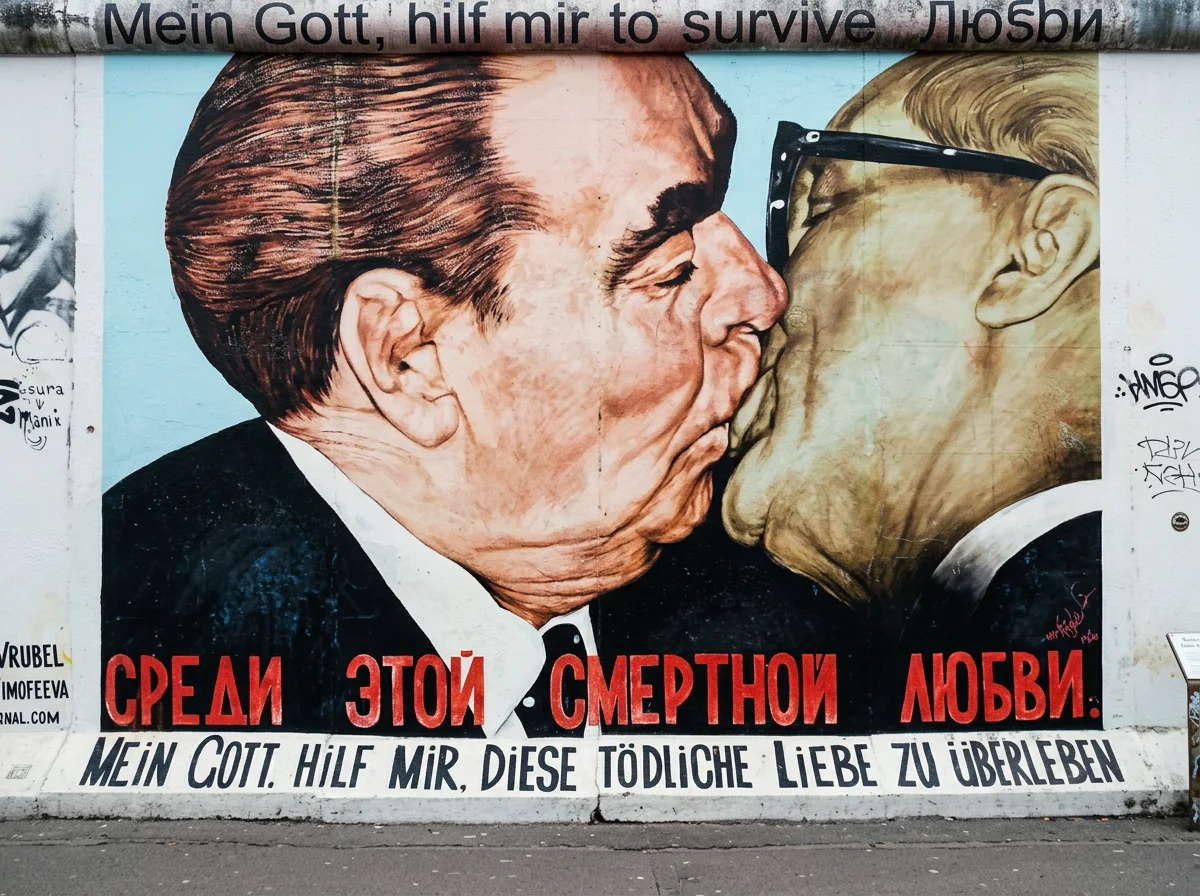
My God, Help Me to Survive This Deadly Love
Friends,
Revisiting the fall of the Berlin Wall always brings back a core memory. As a seven-year-old child, my first television memory was watching people in a distant land dismantling a massive barrier, an event whose historical weight I could not yet fathom. The images of jubilant crowds, hammers in hand, breaking through concrete and decades of division, left an impression that has grown more profound with age and perspective.
It was not until years later, as a college student majoring in international relations, that I began to appreciate the true significance of that night in Berlin. By then, the world had changed dramatically. My generation came of age against the backdrop of September 11th, witnessing firsthand the complexities of global conflict and the responsibilities that come with leadership on the world stage. The United States, propelled by the optimism of the post-Cold War era, had entered its so-called “unipolar moment”—a time when American ideals and influence could shape the emerging world order.
Yet, as Francis Fukuyama famously declared, this was supposed to be “the end of history”: an era of liberal democracy and lasting peace. Instead, the subsequent two decades were marked by missed opportunities and costly misadventures. The Bush administration’s interventions in the Middle East, driven by a mix of idealism and hubris, did not bring about the global stability once imagined. Rather, they exposed the limits of power and the dangers of acting without a clear, collaborative global strategy.
Today, we find ourselves at another crossroads. The erosion of established international norms and rising authoritarianism—not only abroad but also within some of our closest allies—signals that the world is once again in flux. Our nation’s global standing has been challenged by rapid technological change, shifting alliances, and a growing list of transnational threats that do not respect borders: climate change, pandemics, cyber warfare, and economic volatility.
In this turbulent environment, some may be tempted to turn inward, to seek comfort in nostalgia or isolationism. But history teaches us that retreat is not an option. True public safety and global stability require a more collaborative, future-focused approach. The challenges of the twenty-first century—whether they are environmental, economic, or security-related—demand cooperation, not confrontation.
To meet this moment, we must lead the charge toward reforming our international institutions and championing a progressive global system. The neoliberal order, which for decades promised prosperity and freedom, is now struggling to deliver sustainable governance and true liberty for all. Instead, we should embrace a new vision—one that balances national interests with global responsibilities, and that recognizes the interconnected fate of people across continents.
History offers us a cautionary tale. Before World War I, the world enjoyed unprecedented levels of globalization and prosperity, only to witness a devastating collapse into the Great Depression and an era of conflict.
“The inhabitant of London could order by telephone, sipping his morning tea in bed, the various products of the whole earth, in such quantity as he might see fit, and reasonably expect their early delivery upon his doorstep; he could at the same moment and by the same means adventure his wealth in the natural resources and new enterprises of any quarter of the world, and share, without exertion or even trouble, in their prospective fruits and advantages; or he could decide to couple the security of his fortunes with the good faith of the townspeople of any substantial municipality in any continent that fancy or information might recommend. He could secure forthwith, if he wished it, cheap and comfortable means of transit to any country or climate without passport or other formality, could despatch his servant to the neighboring office of a bank for such supply of the precious metals as might seem convenient, and could then proceed abroad to foreign quarters, without knowledge of their religion, language, or customs, bearing coined wealth upon his person, and would consider himself greatly aggrieved and much surprised at the least interference. But, most important of all, he regarded this state of affairs as normal, certain, and permanent, except in the direction of further improvement, and any deviation from it as aberrant, scandalous, and avoidable. The projects and politics of militarism and imperialism, of racial and cultural rivalries, of monopolies, restrictions, and exclusion, which were to play the serpent to this paradise, were little more than the amusements of his daily newspaper, and appeared to exercise almost no influence at all on the ordinary course of social and economic life, the internationalization of which was nearly complete in practice.”
It took extraordinary vision and leadership to build a new international system, culminating in the creation of the United Nations—a bold step that laid the groundwork for decades of relative peace and cooperation.
Now, we stand at a similar inflection point. The postwar institutions that served us well are in need of renewal, and our commitment to global cooperation is more vital than ever. We must resist the temptation to yield to fear or cynicism. Instead, let us reaffirm America’s role as a builder of bridges, not walls; as a partner in progress, not a lone actor on the world stage.
The path forward will not be easy. It will require us to listen, to learn, and to lead with humility as well as determination. But if we rise to the occasion—if we seize this opportunity to forge new alliances, modernize our institutions, and invest in the next generation of global problem-solvers—we can ensure a brighter, safer, and more just future for all.
Thank you for being part of this vital conversation as we look toward Congress 2028 and beyond. Together, we can write the next chapter of American leadership—one rooted in hope, cooperation, and the belief that our best days are still ahead.
In Solidarity,
Gamy Enriquez, MPA