Reparations and Revelations: Toward a Just Future for Latin America
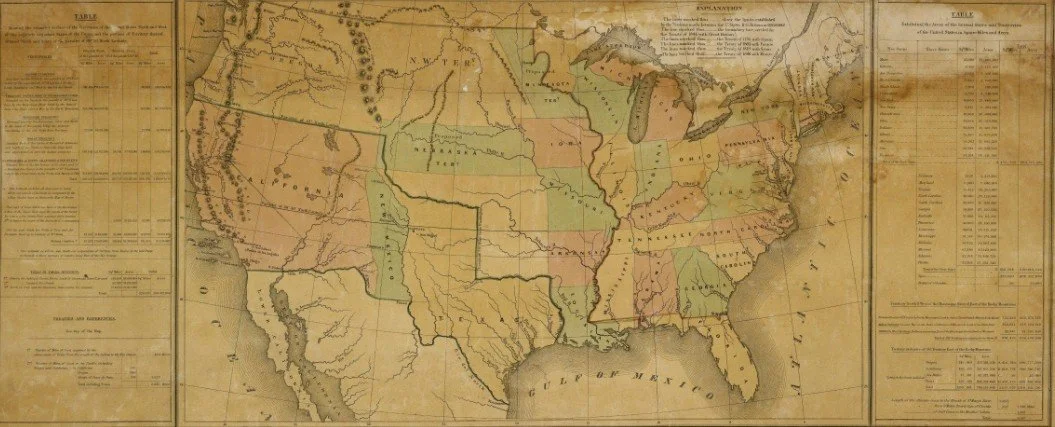
This map was ordered by President James K. Polk to accompany his annual message to Congress in December 1848.
Friends,
Mexican Independence, celebrated on September 16, kicked off a fiesta of liberation movements across Latin America—cheers to that! Mexico declared its independence from Spain in 1810, but the party didn’t really get started until more than a decade of struggle and resilience. The fight for freedom in Mexico inspired neighbors across the region to raise their own glasses (and flags) in pursuit of liberty, reshaping the political landscape of the Americas. Then, in 1823, just as folks were thinking it was time to relax with a margarita, the United States dropped the Monroe Doctrine, making it clear they planned to be the boss of the hemisphere. Not everyone was there for the good vibes—figures like President James K. Polk, John C. Calhoun, and Stephen F. Austin had their eyes on expanding slavery into new territories, stirring up trouble that would lead to the U.S.-Mexican War. Over the next two centuries, more than 200 coups d’état shook Latin America—enough drama to spill your cerveza—creating instability that still sends millions north in search of a better life. So as we celebrate Mexican independence, let’s also recognize the shared struggles and the ties that bind us all together, whether you’re sipping tequila in Tijuana or grilling in Nevada.
For far too long, the narrative surrounding the mid-19th-century conflict between the United States and Mexico has been framed by the victors. The common perception presents the Mexican-American War as a simple border dispute, but the historical record tells a much darker story. It was, in truth, a calculated invasion of sovereign Mexican territory, instigated under false pretenses by President James K. Polk and carried out by military leaders like General Zachary Taylor.
This manufactured war resulted in the loss of nearly half of Mexico's land, creating the vast Southwest that we know today. Many of the states in this region bear Spanish names, and it is home to communities that have always asserted, “We didn’t cross the border; the border crossed us.”
But hey, the story doesn’t end there. Throughout the 20th century, the Monroe Doctrine was used as a hall pass for all sorts of meddling, with the U.S. backing coups and interventions across Latin America—sometimes more often than folks ask for another round of chips at the BBQ. All these shake-ups left a mess that has driven millions to head north, looking for safety, opportunity, and maybe a taste of the American dream (or at least some good Tex-Mex).
Now, you might be wondering—what’s the solution? Reparations aren’t just about justice (though they absolutely are)—they’re also good for national security, democracy, and yes, U.S. interests. If we want to make the hemisphere safer, more stable, and more fun for everyone at the cookout (gringos included!), it’s time to right these historical wrongs and invest in a future where everyone gets a seat at the table—and maybe a plate of carnitas, too.
And this is exactly why I ran for Congress in 2026, and why I’ll be running again in 2028. Reparations—which can and should take the form of economic and political concessions—are long overdue. It’s time to bring everyone to the table and make good on the promise of justice, opportunity, and a brighter future for all.
So, the next time a gringo who doesn't know their history tells you to "go back to your country" or insists that we should "only speak English," remind them that Nevada, California, and Colorado are all Spanish names. In fact, with so many places named in Spanish, everyone here is already speaking the language—whether they realize it or not.
¡Salud!
Gamy Enriquez, MPA
---
References
1. Fowler, Will. "Mexico in the Age of Proposals, 1821–1853." Cambridge University Press, 2012.
2. Brands, H.W. "The Mexican War." Macmillan, 2007.
3. Grandin, Greg. "Empire’s Workshop: Latin America, the United States, and the Rise of the New Imperialism." Metropolitan Books, 2006.
4. Smith, Peter H. "Talons of the Eagle: Latin America, the United States, and the World." Oxford University Press, 2022.
5. Office of the Historian, U.S. Department of State. "The Monroe Doctrine, 1823." https://history.state.gov/milestones/1801-1829/monroe
6. John M. Hart. "Empire and Revolution: The Americans in Mexico since the Civil War." University of California Press, 2002.
7. McPherson, James M. "Battle Cry of Freedom: The Civil War Era." Oxford University Press, 1988.
8. Wikipedia contributors. "List of coups d'état and coup attempts by country." https://en.wikipedia.org/wiki/List_of_coups_d%27%C3%A9tat_and_coup_attempts_by_country