Friends,
If you spend even five minutes scrolling through social media today, you can feel the heavy weight of division. Turn on the news, open a political thread, or listen to public discourse, and the message is nearly always the same: They are coming for you! They are the reason your life is difficult. They are the threat.
For many, this narrative gets channeled through racial politics. It is a loud, chaotic, and intentionally abrasive script designed to pit working-class communities against one another. But what if I told you that this playbook is not new? What if I told you that the strategy of dividing us along racial lines to protect the interests of the powerful is a centuries-old tradition, engineered entirely to distract us from the fact that we are all being played?
To understand how we got here—and how we can finally break free—we have to look back at history, examine a surprising historical figure, and consider how modern masterpieces like the film Just Mercy expose the exact same rigged game.
Meet Hinton Rowan Helper: The Racist Who Saw the Matrix
Let’s take a journey back to the 19th century. Meet Hinton Rowan Helper.
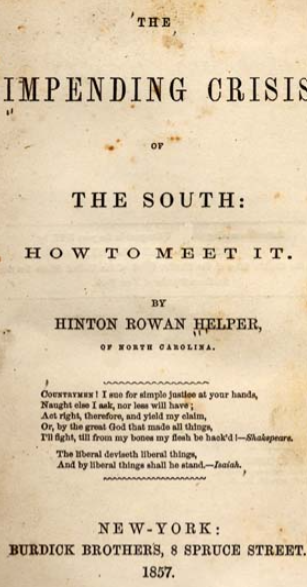
Helper was a white Southerner born in North Carolina in 1829. He was, by all historical accounts, a racist. He held deeply prejudiced views against Black people and was an outspoken white supremacist. But in 1857, Helper published a book that shocked the American South: The Impending Crisis of the South.
What made Helper’s book so explosive wasn't a sudden moral awakening about human rights. Instead, Helper made a purely economic argument. He used hard data, census numbers, and economic metrics to prove that the institution of slavery was actually destroying the lives of poor, non-slave-holding white Southerners.
Helper pointed out that, because the wealthy plantation elite dominated the economy and politics, the South lagged disastrously behind the North in infrastructure, public education, literacy, innovation, and public services. While the top 1% of wealthy slaveholders grew obscenely rich, the remaining 99% of white Southerners lived in crushing poverty—trapped in a backward system.
Helper was a racist, but he wasn’t entirely blind to the structural mechanics of power. He understood that the elite class used racial hierarchy to trick poor white people into supporting an economic system that actively worked against their own survival. He saw how the 1% used division to keep the 99% from uniting around what truly mattered: collective investment in public goods, infrastructure, and a shared future.
The Modern Playbook: From Helper to Modern Bigotry
Fast forward to today, and history is repeating itself with a vengeance.
Unfortunately, many modern racists have evolved past just holding prejudice; they have become full-blown bigots. They are completely paralyzed by hate—locked in an echo chamber where nuance goes to die. Unlike Hinton Rowan Helper, who could at least analyze data and recognize that the economic system was failing the working class, today’s bigots are entirely incapable of viewing the facts.
What are those facts? That the powers that be—the modern corporate and political 1%—deliberately keep us fractured. They pump billions of dollars into culture wars, wedge issues, and racial politics. Why? Because as long as we are fighting each other across racial and cultural lines, we will never look up and notice who is actually robbing us blind.
When we are too busy bickering over manufactured controversies, we don't ask why our public schools are crumbling, why our healthcare system is a predatory maze, why public transportation is failing, or why infrastructure spending is slashed while corporate subsidies skyrocket. The 1% relies on our division. They need us to see each other as enemies so we never realize that investing in robust public services—services that uplift every working-class family regardless of race—is the exact cause that should unite us.
The Cinematic Lesson of Just Mercy
If you want a modern visual manifestation of this exact truth, look no further than the powerful film Just Mercy.
Based on a true story, the movie follows young defense attorney Bryan Stevenson as he travels to Monroeville, Alabama, to take on the case of Walter McMillian. Walter, a Black man, was wrongfully convicted and condemned to death row for a murder he did not commit.
Throughout the film, we watch a local legal and political apparatus—backed by the entrenched "powers that be"—manufacture false testimony, coerce witnesses like Ralph Myers, and double down on a corrupt prosecution. Why? Because the system would rather execute an innocent man than admit a mistake or expose the rot at its core.
Just Mercy is more than just a legal drama; it is a profound exploration of how power protects itself. The bigoted actors in the town are entirely blind to the fact that maintaining a corrupt, biased infrastructure serves only to uphold a rigged hierarchy that preys on everyone at the bottom.
Stevenson’s mission in the film isn’t just about freeing one man. It’s about exposing a system that weaponizes prejudice to maintain control. The movie challenges the audience to look past the smoke and mirrors, recognize the systemic machinery at work, and realize that true justice requires unity against institutions that profit off our collective suffering.
Time to Change the Channel
The parallel is striking. Whether it is the plantation elites of the 19th century keeping poor whites and enslaved people divided, or the modern corporate 1% utilizing cultural wedge issues to fragment the working class, the strategy remains identical: Divide and conquer.
It is time to stop falling for it.
When we let bigotry blind us to the structural realities of our economy, we play right into the hands of the very people exploiting us. The real battle has never been left vs right, liberal vs conservative, or Republican vs Democrat. The real battle has never been between neighbor and neighbor, worker and worker, or race and race.
The real battle is, and has always been, the 99% against the 1%.
It's time to change the script. Let’s stop looking at each other as the enemy, and start demanding the public services, dignity, and justice we all deserve. This is why we must end the business of private for-profit prisons and the death penalty in Nevada and across America.
This is why I am running for Congress—to end the death penalty across America once and for all. Abolishing the death penalty is not just a progressive or liberal cause; it is an imperative that speaks to our shared values across the political spectrum. Progressives and liberals see it as a matter of social justice and human rights, while conservatives can recognize its enormous costs, risk of wrongful convictions, and the profound inconsistency with limited government. Libertarians understand that a government with the power to take life wields too much control over the individual. Instead of perpetuating a system built on punishment and division, we should draw inspiration from Nordic countries, where the focus is on rehabilitation, restoration, and the belief that every person can change. Uniting around this principle will make our justice system more humane, more effective, and more just for everyone—no matter where you stand politically.
In Solidarity,
Gamy Enriquez, MPA