The Social Security Act: Pushback, Debate, and the Promise of a Universal Basic Income
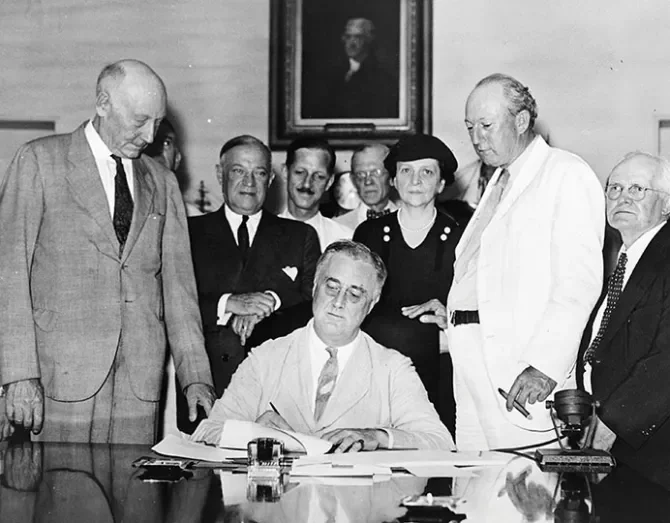
FDR signing the Social Security Legislation with Frances Perkins and members of Congress, August 14, 1935.
In 1935, amidst the ravages of the Great Depression, President Franklin Delano Roosevelt (FDR) signed the Social Security Act into law, establishing a safety net for millions of Americans. While today Social Security is considered a bedrock of American social policy, its passage was far from smooth. The Act faced fierce opposition from across the political spectrum, with notable critiques and defenses voiced by some of the era’s most influential figures.
Pushback from the Political Right
Conservatives of the 1930s saw the Social Security Act as a dangerous step toward excessive government intervention. Republican Senator Daniel Reed of New York famously warned, “The lash of the dictator will be felt,” suggesting that Social Security paved the way for authoritarianism. The American Liberty League, a coalition of business leaders and conservative Democrats, argued that the Act “threatens to undermine the very basis of our government and our society.”
Alfred M. Landon, the Republican nominee for president in 1936, asserted that Social Security would “endanger the economy and individual freedom.” He was quoted as saying, “It assumes that Washington knows best and that the American people cannot be trusted to look after themselves.”
Critiques from the Left
The left, meanwhile, often argued the Act did not go far enough. Louisiana Senator Huey P. Long, a populist firebrand, dismissed Social Security as “a petty program that will leave millions in poverty.” Long’s “Share Our Wealth” program called for far more radical redistribution, and he attacked FDR’s plan as a half-measure: “The time has come for us to demand that the wealth of this nation be shared among the people.”
Dr. Francis Townsend, whose Townsend Plan proposed much more generous old-age pensions, declared, “Social Security is a cruel hoax. It will not provide enough for the aged to live in comfort and dignity.”
Labor organizer John L. Lewis, head of the Congress of Industrial Organizations (CIO), was ambivalent: “We support Social Security as a beginning, but it must be expanded. The American worker deserves more than subsistence in old age.”
FDR’s Defense
President Roosevelt defended the Act with characteristic eloquence, arguing in a 1935 fireside chat, “We can never insure one hundred percent of the population against one hundred percent of the hazards and vicissitudes of life. But we have tried to frame a law which will give some measure of protection to the average citizen and to their family against the loss of a job and against poverty-ridden old age.” He rebuffed critics from both sides, insisting, “This law represents a cornerstone in a structure which is being built but is by no means complete.”
Comparing Social Security to Universal Basic Income
Nearly a century later, the Social Security Act remains a landmark achievement, but the conversation around economic security continues to evolve. One of the most prominent proposals today is Universal Basic Income (UBI)—a policy that would provide all citizens with a regular, unconditional sum of money, regardless of employment status.
The Social Security Act was designed as a safety net for the elderly, unemployed, and disadvantaged, funded by payroll taxes and distributed based on need and work history. UBI, by contrast, is universal and not tied to employment or age. Its intention is to lift everyone above a basic standard of living, addressing issues such as technological unemployment, economic inequality, and the volatility of modern labor markets.
Supporters of UBI often cite the limitations of Social Security, especially as the workforce changes. As Martin Luther King, Jr. wrote in 1967, “The solution to poverty is to abolish it directly by a now widely discussed measure: the guaranteed income.” Nobel laureate economist Milton Friedman, a conservative, also endorsed a form of basic income: “We should replace the ragbag of specific welfare programs with a single comprehensive program of income supplements in cash.”
A Green Marshall Plan for Nevada: Building on the Legacy
In Nevada, the prospect of a Green Marshall Plan—a large-scale investment in renewable energy, sustainable infrastructure, and workforce retraining—offers an opportunity to pair UBI with economic renewal. By channeling public and private funds into green projects, Nevada could become a model for how UBI and climate action reinforce each other. A guaranteed income could cushion workers transitioning out of fossil fuel industries and empower all Nevadans to participate in a clean-energy future.
Critics of UBI echo concerns once raised about Social Security: cost, potential disincentives to work, and questions of fairness. Yet, just as the Social Security Act overcame political resistance and financial skepticism, a Green Marshall Plan with UBI could demonstrate that bold public policy can meet the needs of a changing society.
Conclusion
The pushback that greeted the Social Security Act reminds us that every major step toward economic security has faced fierce debate. By learning from history and adapting to new realities, we can imagine a future where economic security is not only preserved but expanded—a future in which Nevada leads the way.
Gamy Enriquez, MPA
Independent Democratic Candidate, NVCD-02
References
1. Social Security Administration, "Historical Background and Development of Social Security" (https://www.ssa.gov/history/briefhistory3.html)
2. FDR Presidential Library, Fireside Chats (https://fdrlibrary.org/fireside-chats)
3. Alan Brinkley, "Voices of Protest: Huey Long, Father Coughlin, and the Great Depression" (1982)
4. Milton Friedman, "Capitalism and Freedom" (1962)
5. Martin Luther King, Jr., "Where Do We Go from Here: Chaos or Community?" (1967)
6. American Liberty League, archival pamphlets (Library of Congress)
7. Congressional Record, 1935-1936 debates on the Social Security Act
8. Nevada Green Marshall Plan public policy proposals, Nevada Department of Energy