Considering the Call: Resilience, Reform, and the Road to Nevada’s 2nd Congressional District
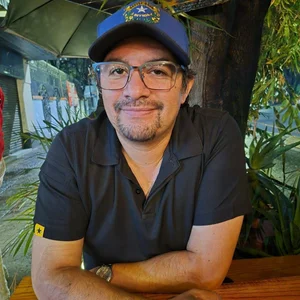
My name is Gamaliel Zavala Enriquez.
"Gamaliel" means "God rewards" and traces to Gamaliel the Elder, a wise and tolerant first-century Jewish teacher whose legacy inspired my belief in resilience and justice.
"Zavala" is Basque for "wide" or "broad," first appearing in medieval Spain and often linked to landowners.
"Enriquez" entered Spain during the Visigothic era, rose to prominence with the House of Enríquez in Castile, and was later adopted by Sephardic Jews.
The name means "son of Enrique," and the House was founded by Alfonso Enríquez, son of King Alfonso XI.
When Alfonso became Admiral of Castile in 1405, the family became an elite noble family based in Medina de Rioseco, the "City of the Admirals."
Over generations, my family lost contact with relatives as they migrated to the Americas. I am proud of my mestizo heritage, and my indigenous roots can likely be traced to the Purépecha Empire, also known as the Tarascan Empire. The Purépecha Empire was the second-largest state in Mesoamerica at the time of the Spanish conquest and a powerful rival to the Aztecs. My grandparents eventually settled in Guadalajara, Jalisco—a city renowned for mariachi music and charrería, Mexico's national equestrian sport, similar to an American rodeo. Guadalajara was the colonial capital of Nueva Galicia, which hosted Miguel Hidalgo during the Mexican War of Independence, and later became the capital of Jalisco after independence.
My story begins in the fields, where my mother picked crops. Her father was a Bracero brought to the US during World War II to help feed America. My father's father was a Zapatista, fighting for land, dignity, and justice during the Mexican Revolution. Like many in Nevada, my family sought opportunity and a better life through hard work, undeterred by adversity. Their journey was defined by resilience—by beating the odds, again and again, no matter the obstacles.
I was born in the US in 1981, the same year Ronald Reagan became president. My sister was born in 1986, and since she could not pronounce my first name, she coined the nickname “Gamy.” My earliest memory of TV is watching the Berlin Wall fall on PBS. My parents worked seven days a week, eventually moving from field laborers to small business owners and homeowners. I grew up helping them at the Starlite Swapmeet in South El Monte, a vital hub for Latino immigrants and working-class families in Los Angeles.
The swap meet provided an accessible entry point for immigrant families to start small businesses and earn a living with relatively low overhead costs, often becoming the basis of a family's income. The Starlite was a place where the Latino community could socialize, hear familiar music like cumbia or norteño, and eat traditional delicacies, fostering a strong sense of belonging and community in an otherwise industrial urban area. In an age of increasing suburbanization and, at times, systemic racism, the swap meet offered an informal refuge and a "hassle-free" shopping experience for Latino residents where Spanish was commonly spoken and cultural norms were understood and celebrated. The physical space, a former drive-in theater lot, was transformed by vendors every weekend using tarps, metal poles, and modified vehicles, demonstrating a unique form of "enacted environment" and entrepreneurial ingenuity that adapted the urban landscape to the community's needs.
From about the age of five to seventeen, I spent every weekend helping my parents at the swap meet, loading and unloading our old blue Dodge van. Decades later, my mom joked about tying my baby chair to the booth pole! Beginning in middle school, I also worked for a nearby Jewish American family as their bilingual salesperson, selling everything from phone cords and hair accessories to model scale cars—classics such as 1957 Corvette Convertibles and 1967 Ford Mustangs.
I learned about diversity and business early, working for the Jewish American family—who paid me—while my own parents said food and shelter were payment enough. Before my teenage years, I joined my first protest: against California’s Proposition 187, which aimed to deny public services to undocumented immigrants. Protesters gathered at the swap meet, making it my first taste of activism.
Throughout high school, I earned a steady $120 a week from my weekend job. I even sold number 2 pencils on exam days.
Thanks to teachers like Mr. Terry Matthews, Mr. Mark Johnson, and Cris Rosales, I managed to juggle academics, extracurriculars, community outreach, and my weekend job. I often did my homework during two-hour bus rides on public transportation.
With guidance but unwavering resilience, hard work, and a bit of luck, I graduated from high school and was accepted to college in Northern California. In the summer of 1999, after graduation, I took a Greyhound overnight to visit campus and pay my dorm deposit. That fall, at seventeen, I boarded a Greyhound again with two suitcases, determined to pursue higher education despite the odds stacked against me. I remember thinking I had to succeed, as the eldest, to take care of my family, because the family business we had built went under due to NAFTA, and that was my top priority. It is no coincidence that a couple of years later, my father had a heart attack.
I came of age in the aftermath of September 11, 2001. As a first-generation college student, I remember questioning why we were attacked and why the U.S. was going to war.
Seeking answers, I majored in international relations, hoping to become a human rights advocate and career diplomat. On the second anniversary of 9/11, I found myself studying abroad in Madrid, learning European history and gaining global perspectives. I interned at the World Affairs Council, meeting key figures in U.S. foreign policy. An encounter with diplomat Joseph Wilson, who exposed false intelligence before the Iraq War, left a lasting impression on me.
At the time, I didn’t realize how much America was a two-tiered society—with one set of rules for the 1% and another for the 99% of us.
College was more expensive than I expected. As a result, I dropped out, became homeless as the housing bubble drove up costs, then lost my job in Las Vegas as a result of the Great Recession and became entangled in the criminal justice system.
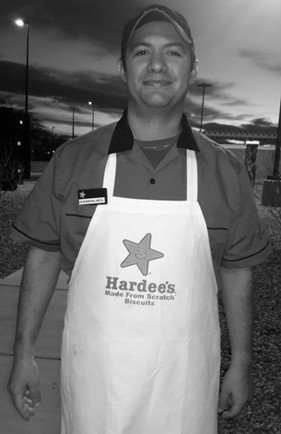
In 2015, while under pre-trial supervision and barred from sales jobs, I worked as a cook at Popeyes, among other fast-food restaurants. During this time, I was inspired by Bernie Sanders’ call for economic justice. I became an activist, fighting for a $15 minimum wage, encouraging voter turnout, and serving as a Bernie delegate. I later served as Deputy Canvass Manager for Hillary Clinton and Catherine Cortez Masto, and worked to elect officials across the Silver State for the next decade in various capacities. I began to see clearly during this period that, if higher education were a right, I might have graduated with peers who are now at the State Department and the United Nations, protecting America’s interests and values.
With the benefit of hindsight, if housing were a human right, I wouldn’t have become homeless, as so many Americans do. If financial regulations protected everyone, not just the privileged, Wall Street CEOs would have faced consequences instead of Main Street paying the price.
Since the 1970s, American politics has become more polarized. Today, the political status quo, the established order, the monopoly that is the two-party system, offers two faces of capitalism: MAGA Republicans promote xenophobia and working-class exploitation. In contrast, Corporate Democrats offer a gentler neoliberalism, supporting mass deportation and aggressive foreign policy.
We need leaders who represent their constituents and stop funding endless wars. Our politics should put human rights and dignity first. That’s why I strongly supported Nevada’s Question 3 in 2024—a needed disruption to the political and economic elite who profit at our expense.
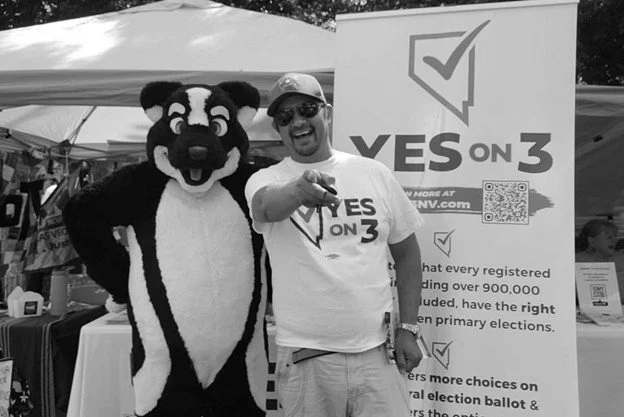
Open primaries and ranked-choice voting, as proposed in Question 3, were the strategic response to the persistent dysfunction and extremism at local, state, and national levels of government. It offered a way to achieve real results for the people. We reform the system. We get different results. Yet, it comes as no surprise that both parties opposed the nonpartisan electoral reform measure.
I know that many can relate to these hardships. But with the steadfast support of family and friends—and above all, a resilience that refused to let me quit—I beat the odds. I earned a BA in political science from Arizona State University, a Master’s in Public Administration and Policy from the University of Nevada, Reno, and started a coffee importation business.
But I didn’t get here alone, and neither does anyone in the working class. We lift each other up. That’s what Nevada is about—community, solidarity, and resilience. But let’s be honest: for far too long, politicians in both parties have left us behind. They tell us to tighten our belts, but give away billions to the wealthy, to corporations, to wars that never end. Meanwhile, ordinary Nevadans are working two or three jobs, struggling to pay rent, keep the lights on, afford a doctor, or send their kids to college.
We deserve better. We deserve a Nevada where housing is a human right—where no family has to sleep in their car, where rent doesn’t swallow your paycheck. We deserve a Nevada where higher education is universally free and accessible, not a privilege for the few. We deserve a Nevada where healthcare is guaranteed, and no one goes bankrupt because they get sick. We deserve a Nevada where our government works for us—not just for the billionaire class.
I have the right combination of education, work experience, and lived experience. I have experience building a broad coalition and reaching across the Left/Liberal and Right/Conservative divides. I have the most strategically relevant public policy solution, which is a universal basic income, appealing to the entire political spectrum. I have deep relationships with Indigenous communities, communities of color, in particular Black communities, and Hispanic and Latino communities, as well as white communities. Furthermore, I have already been doing community outreach as a gig worker, doordashing, and helping small business owners stay in business since COVID began. My wife is one of two lead singers in a band and sings in English, Spanish, and Portuguese, and my father-in-law is an Emmy Award-winning watercolor artist, so we can mobilize through music and art. As a graduate of UNR, I am very well connected to the University of Nevada, Reno campus, so I have already been doing deep canvassing with young people. But I am a potential candidate, as at this time, there are many moving parts, and I am continuously assessing the political landscape along with family, friends, and the larger NV CD-2 community. I want the best candidate to emerge to defeat Mark Amodei. I continue to study whether or not to run with friends, family, and the larger NV CD-2 community.
So what is my vision for victory on November 3, 2026? Central to a successful platform will be taxing the rich and making corporations pay their fair share through a value-added tax that funds a universal basic income. We invest that money back into our communities—into housing, schools, childcare, public transportation, and green jobs right here in Nevada. We end the endless wars and bring those dollars home to help our people. We build a just, sustainable economy for all.
Let’s reject the politics of division. Let’s reject the false choices offered by both parties—the endless scapegoating, the broken promises, the empty rhetoric. Nevada is stronger when we stand together, no matter where we’re from, the color of our skin, or the language we speak at home. We are the backbone of this state. We are the people who make Nevada run, and it’s time our voices are heard. It’s time we demand a government that works for us, not just the rich and powerful. Together, we can build a Nevada where everyone has a roof over their head, a good job, quality healthcare, and the chance for their children to dream big and succeed.
Every step of my journey has been a testament to the power of resilience—of refusing to give up when the world says you should, of rising each time you fall, of daring to hope when hope seems out of reach. Beating the odds is not just my story—it is the story of countless Nevadans, of working families everywhere who push forward through hardship and uncertainty. Our struggles do not define us; our resilience does.
Let us remember: the odds may be long, but they are never insurmountable. When we stand together, when we lift each other up, there is nothing we cannot achieve. The future belongs to the resilient—to those who refuse to be broken, to those who keep fighting for a better tomorrow. Let us be that future. We are battle born. Let us beat the odds—together!
Gamaliel “Gamy” Zavala Enriquez earned a B.S. in political science from ASU and an MPA in policy at UNR. Gamy has 10 years of experience as a campaign manager and activist in Nevada. Editorial assistance provided by a generative AI tool for grammar and clarity.